India recorded 5.13 lakh road accidents in 2025, resulting in 21 deaths per hour, according to Ministry of Road Transport and Highways data published in July 2026. The scale of the problem is significant, and cities are increasingly looking at technology to improve how traffic violations are detected, documented, and processed.
AI traffic enforcement is one part of that shift. This guide explains what it is, how it works, what it can and cannot do, and how citizen-powered AI reporting fits into the broader enforcement ecosystem.
What Is AI Traffic Enforcement?
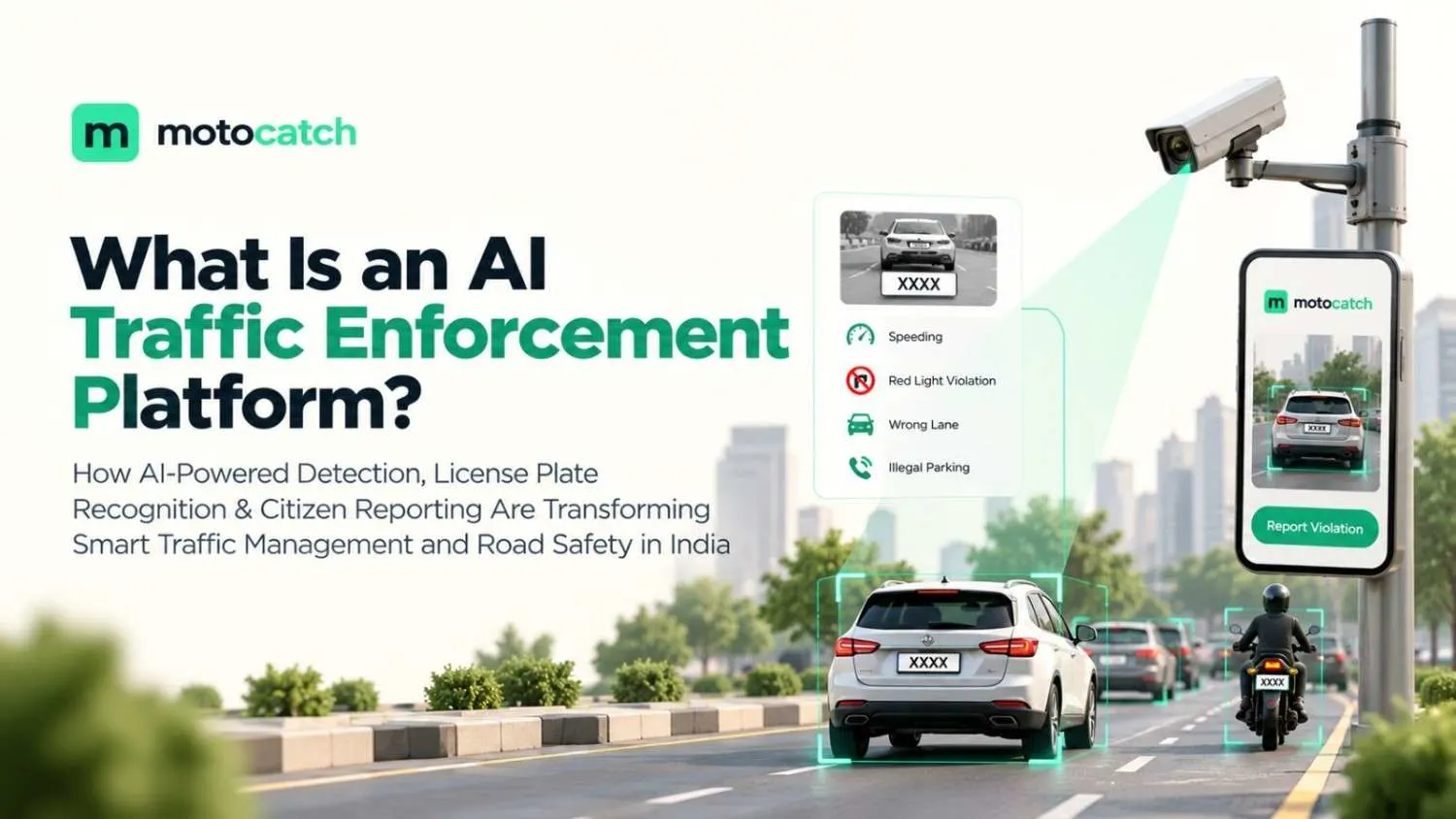
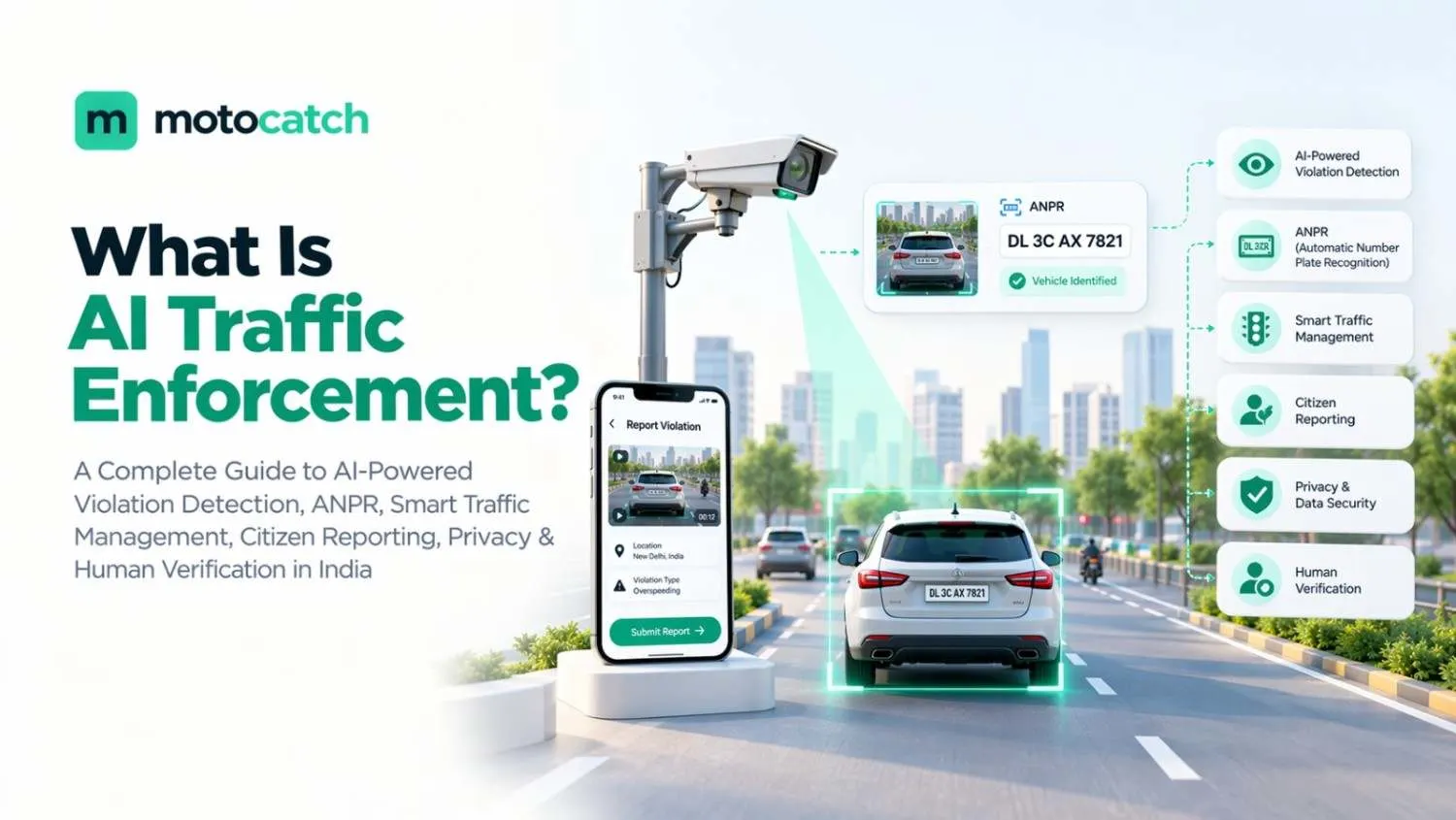
AI traffic enforcement is a broad category of systems that use artificial intelligence, computer vision, and connected technologies to detect and process traffic violations.
In a typical fixed-camera deployment, cameras monitor roads and AI systems analyse the footage for events such as red-light violations, speeding, lane violations, or helmet non-compliance. Depending on the infrastructure and authority integrations involved, the detected information can then be reviewed and processed through the relevant enforcement workflow.
AI traffic enforcement can also include wider smart traffic management capabilities such as traffic monitoring, adaptive signal control, incident detection, and command dashboards.
MotoCatch operates within this broader AI traffic enforcement category, but its model is different from a government-operated fixed-camera enforcement network. Instead of depending entirely on dedicated enforcement cameras, MotoCatch can analyse existing road footage, including footage captured by citizens, and help turn it into structured evidence for review.
The distinction is important: AI traffic enforcement is the broader category; MotoCatch applies AI analysis to existing and citizen-generated footage to support the reporting process.
How AI Traffic Enforcement Works
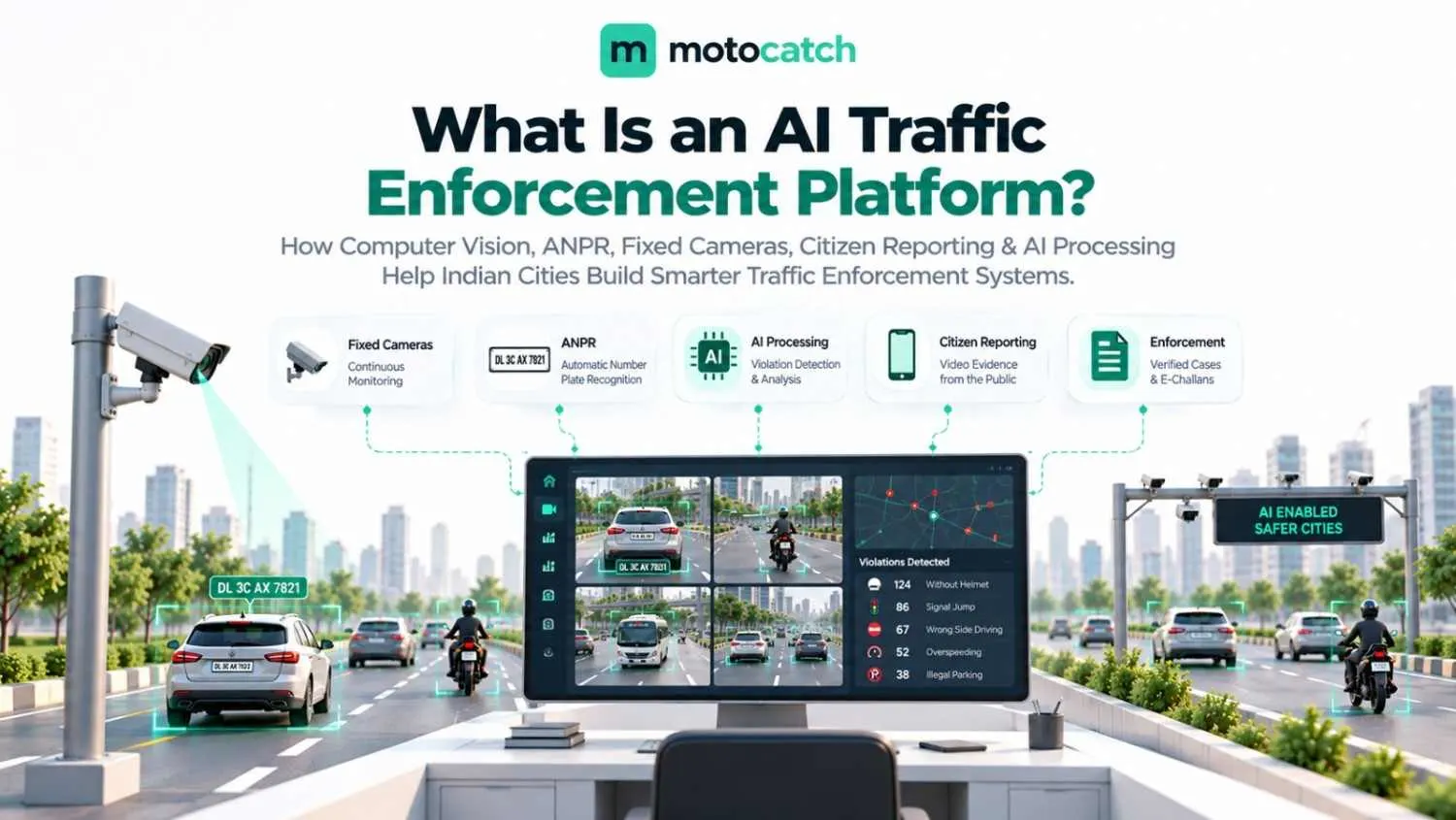
A modern AI traffic enforcement platform is not a single camera on a pole. It is a connected system with several components working together.
Computer Vision and Violation Detection
At the core is computer vision — AI models trained to recognize specific events in video footage in real time. These models can identify:
- A vehicle crossing a stop line on red
- A two-wheeler rider without a helmet
- A vehicle exceeding a set speed threshold
- A car changing lanes without indication
- Triple riding on a two-wheeler
- A driver using a mobile phone while moving
- Seat belt non-compliance
Modern systems using YOLOv5 and similar deep learning architectures can detect these violations across multiple lanes and different environmental conditions.
AI Number Plate Recognition
AI number plate recognition — technically known as Automatic Number Plate Recognition or ANPR — helps identify the vehicle involved in a detected incident.
The system reads the vehicle's registration plate from the footage and can provide vehicle identification information for the next stage of the enforcement process.
The exact use of this information depends on the deployment, available databases, and integration with the relevant authority. ANPR capabilities can vary between systems and jurisdictions.
Adaptive Signal Control
AI-powered traffic systems can also use live traffic information to support adaptive signal control. Instead of relying only on fixed signal timings, these systems can analyse traffic density and adjust signal timing based on current conditions.
At Electronics City in Bengaluru, an ITMS implementation has been reported to reduce average waiting times at signals by 35–40%.
Command and Control Dashboard
Connected traffic systems can bring camera feeds, violations, alerts, and traffic analytics into a central dashboard.
Operators can use this information to review flagged incidents, monitor traffic conditions, and understand where violations or congestion are concentrated.
The exact capabilities depend on the infrastructure and systems connected to the platform.
How MotoCatch Fits into AI Traffic Enforcement
MotoCatch applies AI-powered analysis to existing road foot MotoCatch applies AI-powered analysis to existing road footage, including footage captured by citizens.
Rather than requiring a dedicated government camera network at every location, the platform focuses on processing footage that is already available and turning it into structured information.
The MotoCatch workflow is:
Existing/Citizen Footage → AI Analysis → Violation & Vehicle Identification → Structured Evidence → Review
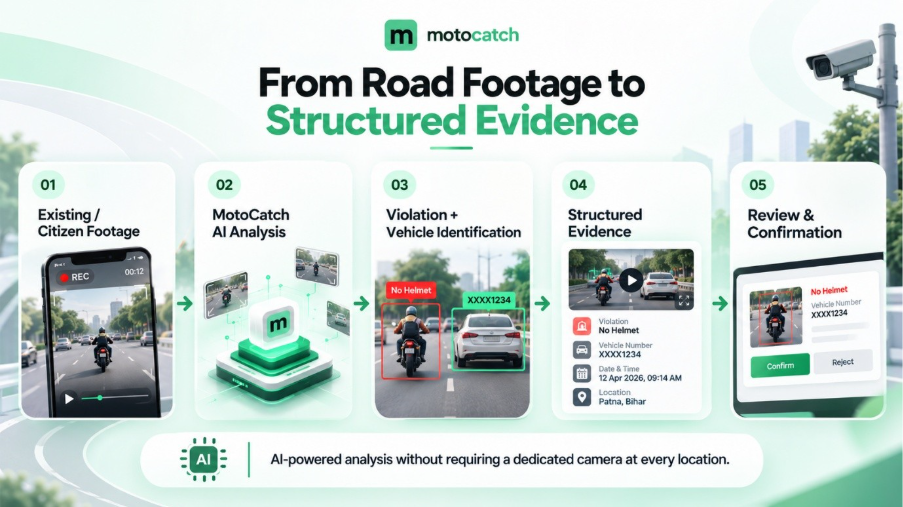
Existing or Citizen Footage
The process starts with available road footage. This can include footage captured by a citizen or footage from an existing camera source.
AI Analysis
MotoCatch analyses the footage using AI to identify relevant information from the incident.
Violation and Vehicle Identification
The system can help identify the potential traffic violation and relevant vehicle details, including number plate information where the footage supports it.
Structured Evidence
The identified information is organised into structured evidence rather than requiring the citizen or reviewer to manually extract every detail.
Review
The resulting information can then be reviewed and confirmed before moving through the appropriate reporting or enforcement process.
This makes MotoCatch different from a fixed-camera enforcement network. The focus is not on replacing existing infrastructure, but on adding an AI processing layer that can work with available road footage.
AI Traffic Violation Detection in Practice
AI traffic violation detection can significantly reduce the amount of manual processing involved in reviewing large volumes of road footage.
Instead of requiring people to manually examine every frame, computer vision can identify potential violations and surface relevant footage for further review.
However, AI detection does not remove the need for human involvement entirely.
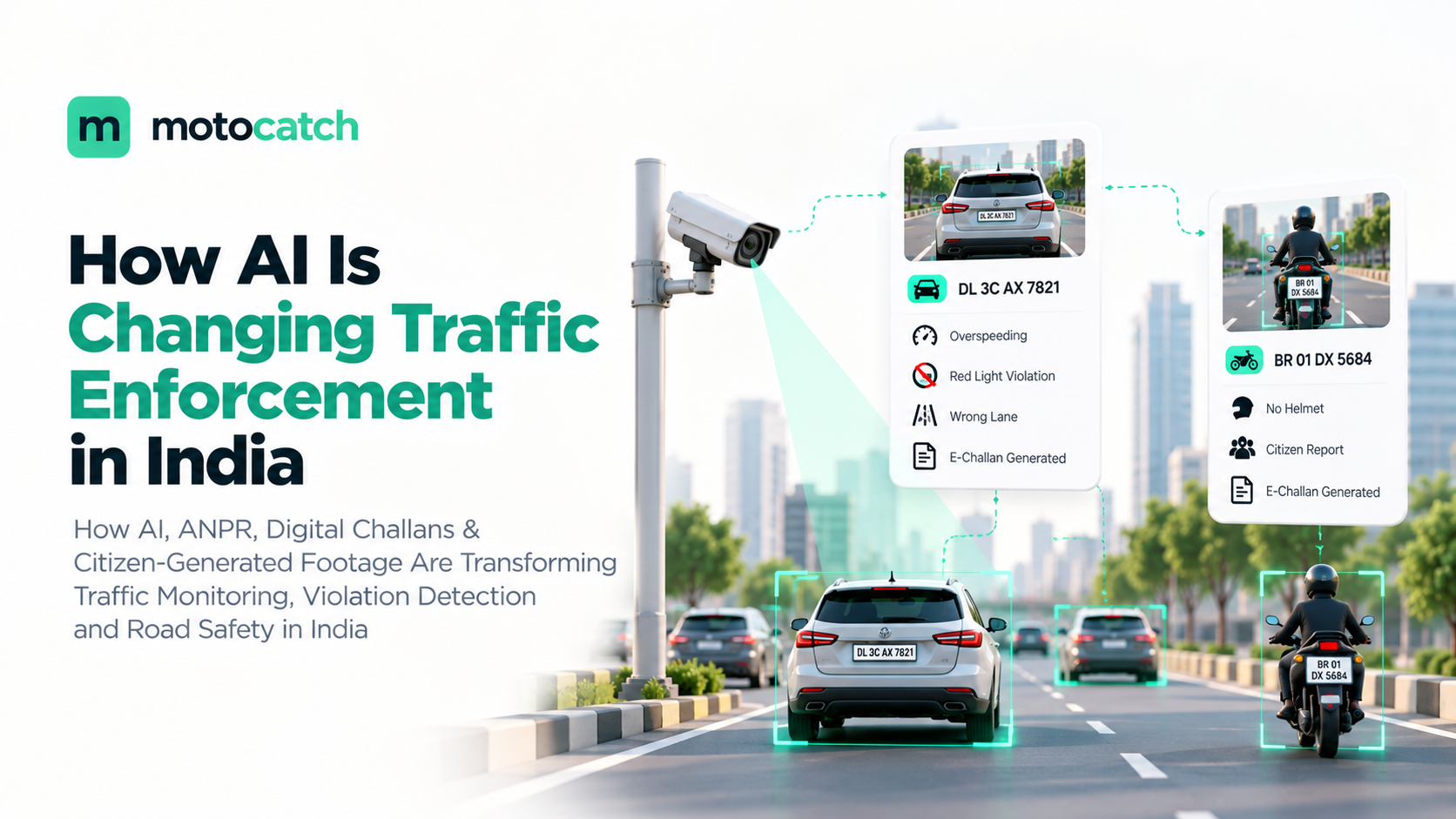
Edge cases, unclear footage, disputes, unusual situations, and enforcement decisions may still require human review. This is also the theme in how AI is changing traffic enforcement in India, where AI supports detection and evidence processing rather than replacing human judgment.
What Is a Smart Traffic Management System in India?
A smart traffic management system in India is more than an enforcement tool. It is a city-level infrastructure layer that connects traffic data, enforcement systems, and command-and-control dashboards into a single operational picture.
The Bengaluru Traffic Management Centre, for example, operates systems that provide authorities with real-time visibility across the city's road network.
A modern smart traffic management system can include:
- Adaptive signal control
- Real-time congestion monitoring
- ANPR-integrated enforcement
- Incident detection
- Command and control dashboards
These systems are designed to help authorities manage both traffic flow and enforcement using connected data.
CCTV vs Citizen Reporting of Traffic Violations
Two important approaches to traffic violation reporting are fixed CCTV infrastructure and citizen reporting.
Both have strengths and limitations.
Traditional CCTV
Traditional CCTV gives authorities fixed points of observation and allows footage to be reviewed when needed.
Its limitations include:
- Fixed coverage — cameras only monitor locations where they are installed
- Passive recording — footage may require manual review
- Processing requirements — reviewing large volumes of footage can take significant time
- Infrastructure dependency — cameras require installation, maintenance, and connectivity
CCTV remains an important part of traffic enforcement, but camera coverage cannot extend to every road or every moment.
Citizen Reporting
Citizen reporting adds another source of road-level information.
Citizens can potentially capture incidents in areas without dedicated camera coverage and submit photographs or videos through appropriate reporting channels.
However, citizen reporting also has limitations:
- Evidence quality can vary
- Number plates may not always be readable
- Location or time information may be missing
- Each report may require review
- Participation depends on individual motivation
This is where AI-assisted reporting can help reduce some of the processing burden.
What AI Enforcement Adds
The value of AI is not simply replacing manual enforcement.
It is about reducing the processing burden and enabling evidence to be structured at scale.
AI can analyse large volumes of footage, identify potential violations, extract relevant vehicle information, and organise evidence for subsequent review.
For fixed-camera systems, this can help authorities process footage from monitored locations more efficiently.
For citizen reporting, it can help turn raw photographs or videos into more structured information without requiring citizens to manually identify and enter every detail.
The human role remains important. AI can assist with detection and organisation, while appropriate reviewers and authorities remain responsible for verification and enforcement decisions.
AI Enforcement and Privacy
AI traffic enforcement involves the processing of visual and vehicle-related information, which makes privacy an important consideration.
Privacy requirements, data handling practices, retention periods, and the use of identifiable information can vary depending on the system, deployment, jurisdiction, and applicable legal requirements.
For that reason, privacy and legal compliance should be evaluated as part of the design and deployment of any AI traffic enforcement system.
The technical architecture should consider how evidence is collected, processed, stored, accessed, and shared, with appropriate safeguards built into the system.
What AI Traffic Enforcement Cannot Do
It is worth being direct about the limitations:
- AI systems make errors. Number plate misreads can happen, especially with damaged or non-standard plates. Appropriate review and appeal mechanisms remain important.
- Camera coverage is still finite. Fixed-camera AI enforcement only works where the required infrastructure is present. Rural roads and unmapped intersections can remain outside the system.
- Enforcement alone does not change behaviour at population scale. Road safety also requires education, infrastructure improvements, and responsible road behaviour.
- Training data can affect system performance. Systems may perform differently across vehicle types, road conditions, lighting conditions, and violation categories.
- Human review remains important. Unclear evidence, disputes, and unusual situations may require human assessment before enforcement action.
These limitations do not make AI enforcement less useful. They make thoughtful implementation, testing, review processes, and transparent reporting important.
What Could the Future Look Like?
The future of road safety is likely to involve several technologies working together.
Traffic police can provide direct enforcement and verification. Fixed cameras can provide continuous monitoring at selected locations. AI can assist with detection and evidence processing. Citizen reporting can provide additional road-level information from locations outside fixed camera coverage.
The opportunity is to connect these different sources so that authorities can work with better and more structured information.
Conclusion
AI traffic enforcement is becoming an important part of how cities and authorities approach traffic monitoring and violation detection.
But AI does not work in isolation.
Fixed infrastructure provides continuous monitoring at selected locations. Citizen reporting can extend road-level visibility beyond those locations. AI can help analyse footage and structure evidence, while human reviewers and traffic authorities remain responsible for verification and enforcement decisions.
MotoCatch fits into this ecosystem by applying AI analysis to existing and citizen-captured footage, helping transform raw road footage into structured information that can be reviewed through the appropriate process.
The opportunity is not simply to add more technology to traffic enforcement.
It is to make better use of the footage, information, infrastructure, and human oversight already available.