Indian cities are dealing with a road network that is becoming increasingly complex. Traffic enforcement now involves not only identifying violations, but also managing cameras, signals, vehicle data, control centres, incident detection and evidence from different parts of the road network.
An AI traffic enforcement platform brings these capabilities together. It can help cities process road footage, detect specific traffic violations, identify vehicles where the required systems and permissions are available, and give enforcement teams a more structured view of what is happening across monitored roads.
The important point is that AI traffic enforcement is not simply about installing more cameras. For cities, the larger question is how fixed infrastructure, AI processing, traffic-management systems, citizen-generated evidence and human review can work together.
What Is an AI Traffic Enforcement Platform?
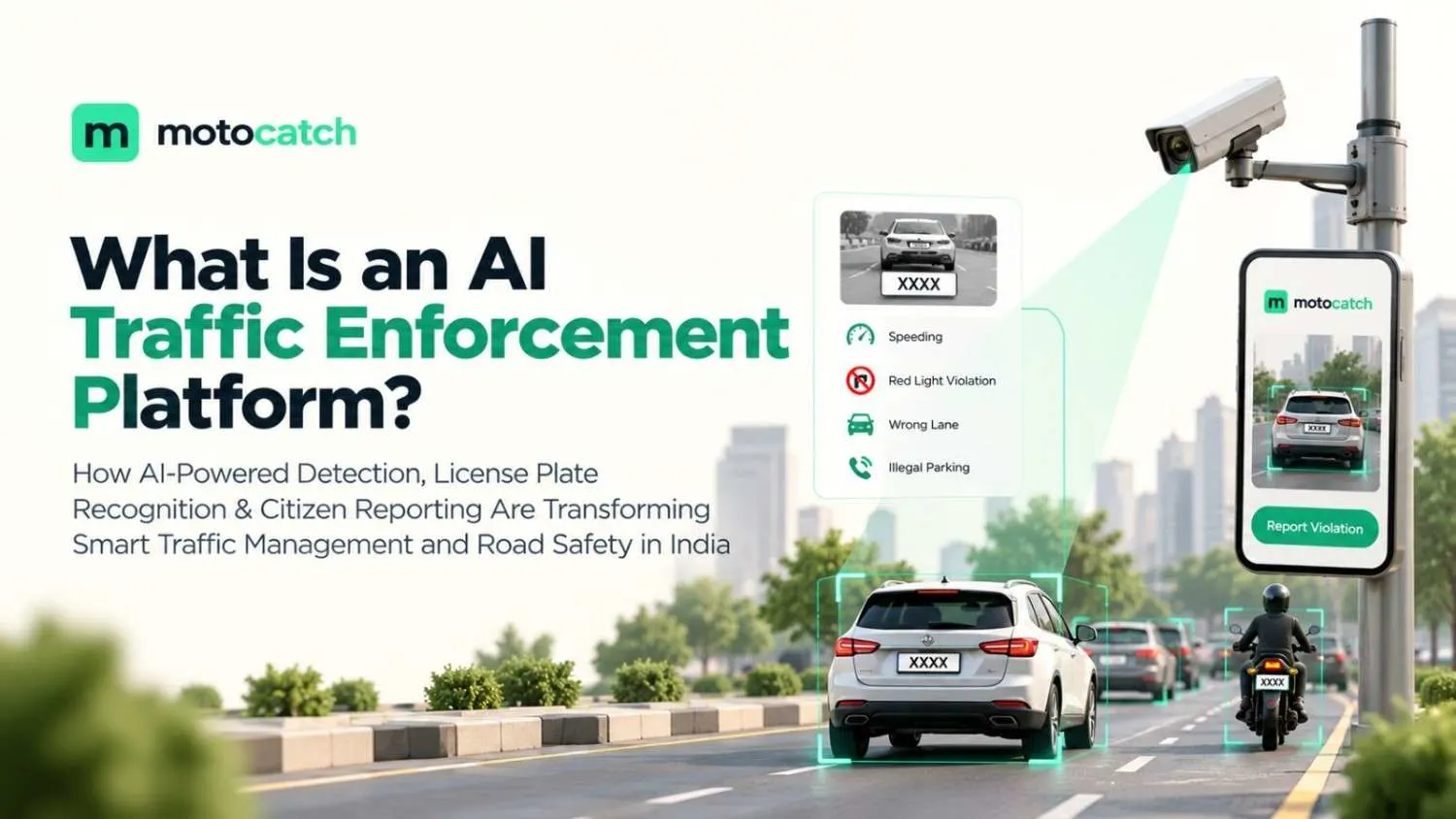
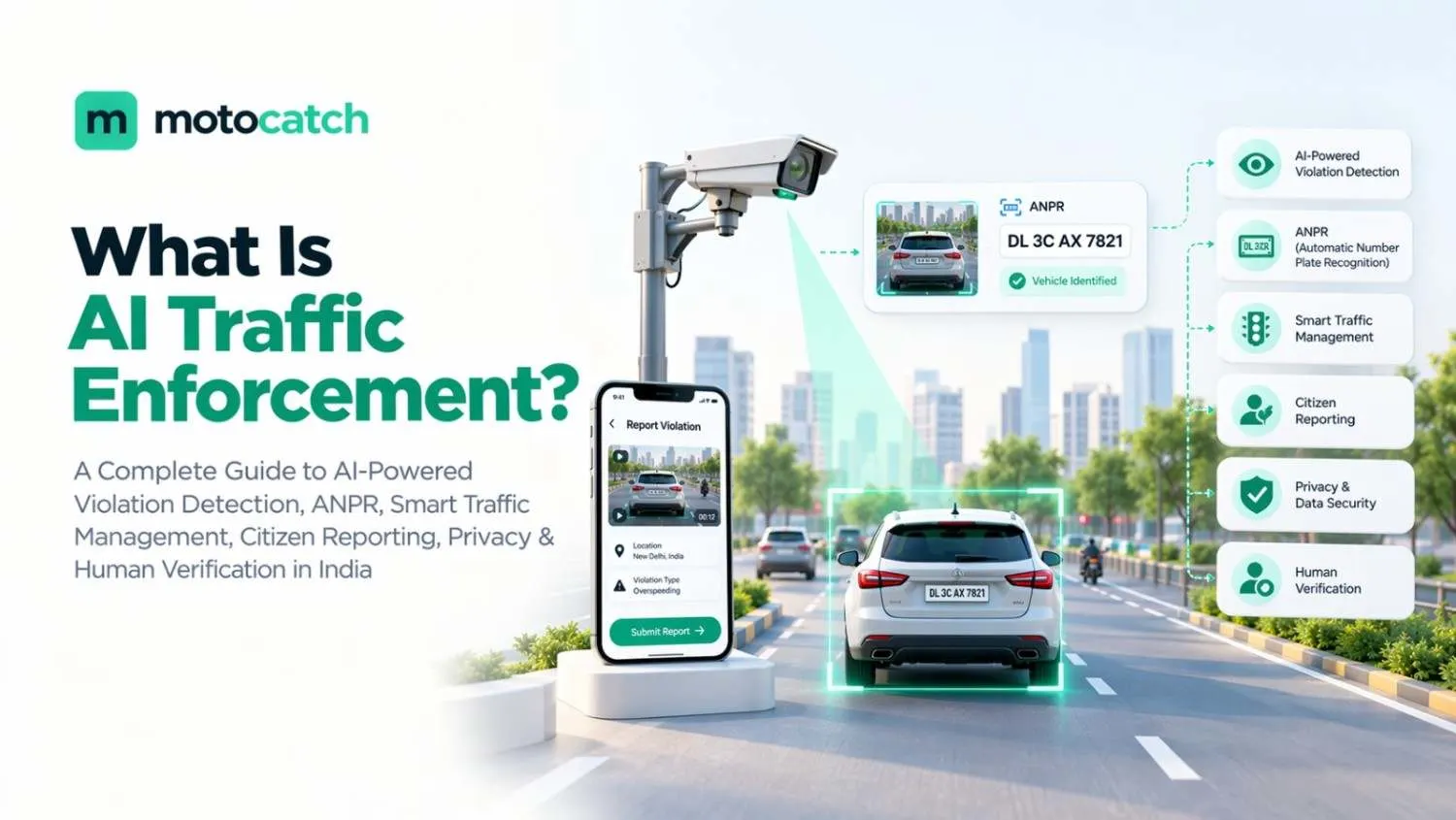
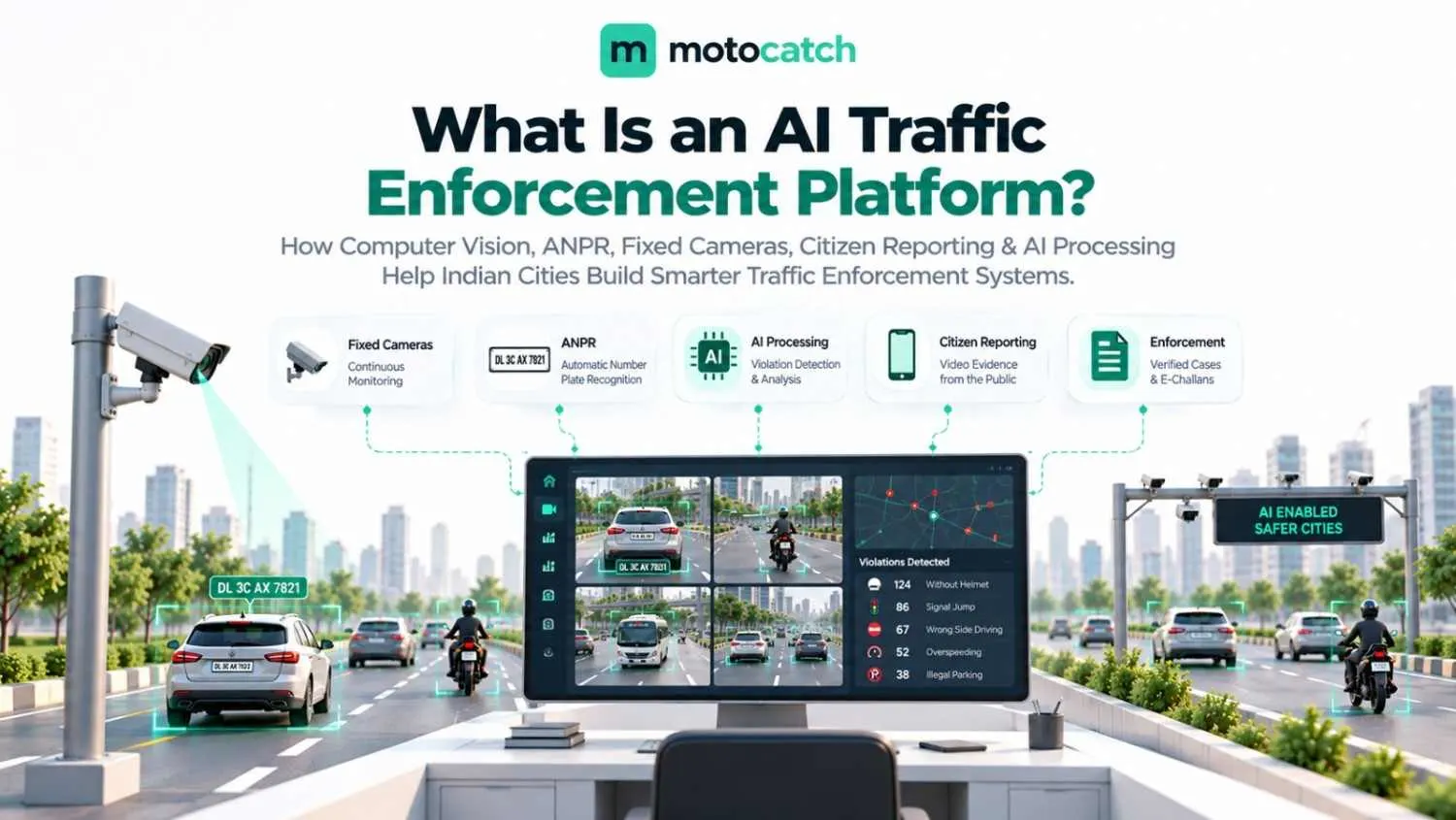
An AI traffic enforcement platform is an integrated system that combines technologies such as computer vision, Automatic Number Plate Recognition (ANPR), adaptive signal control and command-and-control dashboards to support traffic enforcement and road management.
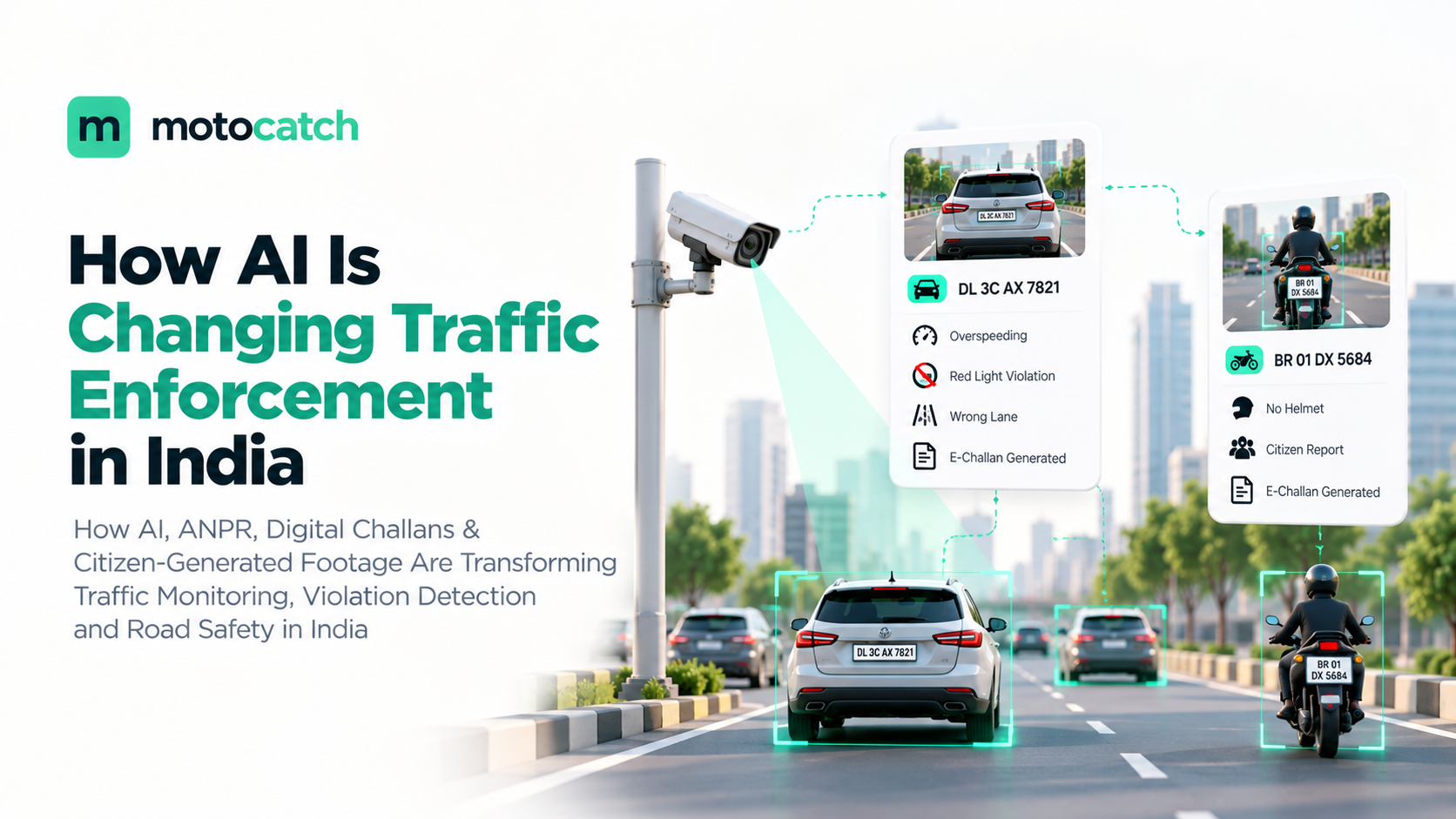
At a basic level, connected cameras capture road activity and AI models analyse the footage for defined events such as red-light violations, speeding or helmet non-compliance.
At city scale, the platform can connect multiple locations and systems, allowing authorities to monitor traffic conditions, review flagged events, analyse recurring violation patterns and coordinate enforcement activity from a central environment.
The value therefore lies not only in detecting an individual violation, but in creating an infrastructure layer that helps cities monitor, process and manage road activity at scale.
The Core Components of an AI Traffic Enforcement System
A modern AI traffic enforcement system is not a single device. It is a stack of connected technologies that work together.
1. Computer Vision and Violation Detection
Computer vision is the foundation of AI-based traffic monitoring. AI models analyse video footage and identify defined events in real time.
Depending on the system and its training, this can include:
- Red-light violations
- Overspeeding
- Helmet non-compliance
- Triple riding
- Seat-belt violations
- Mobile-phone use while driving
- Wrong-side driving
- Illegal lane changes
- Number-plate issues
The exact violations a system can detect depend on the deployed technology, camera setup, model capabilities and operating conditions.
2. Automatic Number Plate Recognition (ANPR)
ANPR uses image-processing technology to read vehicle registration plates from captured footage.
However, ANPR itself does not automatically mean that a system has access to government vehicle databases or challan systems.
For a plate-reading system to retrieve registered-owner information or support an enforcement workflow, it needs the relevant database access, technical integration, permissions and authority-side infrastructure.
India's e-Challan ecosystem does integrate with vehicle and driving-licence databases such as Vahan and Sarathi, but the availability and implementation of these integrations depend on the relevant government systems and authorities.
This distinction matters: ANPR identifies or reads a plate; database access and enforcement integration are separate layers.
3. Adaptive Signal Control
AI-enabled traffic management can also extend beyond violation detection.
Adaptive signal systems use live traffic information such as vehicle density and queue lengths to adjust signal timing dynamically rather than relying entirely on fixed timings.
This allows cities to use the same broader technology infrastructure for both enforcement and traffic-flow management.
4. Command and Control Dashboard
A city-level system needs somewhere to bring the information together.
Command-and-control dashboards can give authorised operators visibility into:
- Live camera feeds
- Flagged violations
- Traffic conditions
- Incident alerts
- Violation hotspots
- Time-based traffic patterns
- Road-network analytics
The purpose is to give enforcement and traffic-management teams a more consolidated view of the monitored network.
How AI Traffic Enforcement in India Is Being Deployed
AI-based traffic management in India is being deployed across highways, junctions and city-level traffic-management environments, rather than through one uniform national system.
Delhi–Gurugram / Dwarka Expressway
NHAI's technical documentation for the Dwarka Expressway and existing NH-8 includes intelligent transportation infrastructure such as surveillance cameras, ANPR cameras, speed detection, adaptive traffic-signal control and provisions for automated e-challan generation.
This illustrates how AI-enabled enforcement can become part of a wider highway infrastructure and command-centre ecosystem, rather than operating as a standalone camera.
Bengaluru
Bengaluru provides another example of city-level technology deployment. The city's ASTRaM platform combines traffic information from CCTV cameras, traffic apps and ground intelligence, while AI-based adaptive signals are being used at major junctions.
The Bengaluru Traffic Police's ASTRaM app also provides traffic updates, accident and violation reporting, congestion alerts and other citizen-facing services.
Bengaluru–Mysuru Highway
AI-enabled traffic-management systems have also been deployed along the Bengaluru–Mysuru corridor. Reporting on the system has documented the use of AI cameras for traffic-violation detection, showing how enforcement technology can be deployed along a defined highway corridor rather than only inside a city.
These examples show different deployment models: city networks, major junctions and highway corridors.
Why Indian Cities Need an AI Traffic Enforcement Platform
The need is not simply about replacing traffic officers with machines.
Indian cities have large and constantly changing road networks. Fixed cameras can provide continuous monitoring at the locations where they are installed, while command centres can help teams process large volumes of information.
But technology does not remove the need for human enforcement.
An effective city-level system can instead help authorities:
- Monitor defined road locations continuously
- Detect specific violations consistently
- Prioritise incidents for review
- Organise large volumes of evidence
- Identify recurring enforcement hotspots
- Understand traffic patterns
- Coordinate action across different parts of the network
This makes AI a force-multiplication and infrastructure tool, rather than a replacement for traffic personnel.
Where Citizen-Reported Data Fits
Fixed cameras are valuable, but no camera network can physically cover every road, junction and moment of traffic activity.
Residential streets, smaller roads, rural highways and newly developing areas may fall outside a city's fixed-camera footprint.
This is where citizen-generated footage can complement fixed infrastructure.
A road user may capture a dangerous overtake, wrong-side driving, red-light violation or another incident on a road that does not have a dedicated enforcement camera. Citizen reporting helps bring such incidents to the attention of traffic authorities. This is one of the ways traffic violation reporting can support safer roads by extending visibility beyond fixed camera locations.
The challenge is then not simply collecting more videos. It is turning those videos into structured, usable evidence that can be reviewed by the appropriate authority. You can read more in our road safety and traffic technology guide.
This creates a complementary model:
- Fixed Cameras
Continuous monitoring at equipped locations - Citizen Reporting
Evidence from roads and incidents outside fixed-camera coverage - AI Processing
Identification, classification and structuring of relevant evidence - Human Review
Authority-led verification and enforcement decisions
This is where platforms such as MotoCatch can fit into the wider AI traffic-enforcement ecosystem.
MotoCatch can help process citizen-captured footage, identify relevant vehicle and violation information, and structure the evidence for reporting and review.
It does not replace the authority's enforcement workflow.
Fixed Cameras + Citizen Reporting + AI
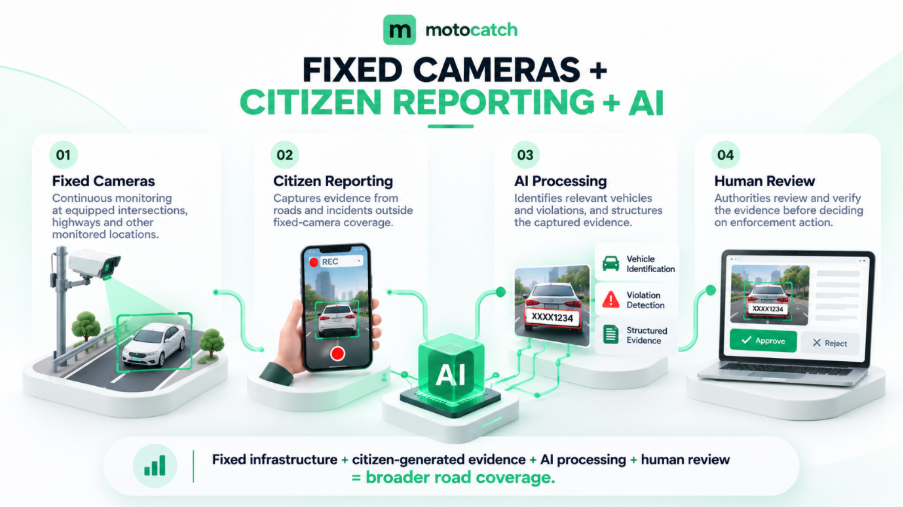
A city does not necessarily have to choose between camera infrastructure and citizen reporting.
The two can work together.
Fixed Cameras
Provide continuous monitoring at selected intersections, highways and other equipped locations.
Citizen Reporting
Extends visibility to locations and incidents outside fixed-camera coverage.
AI
Helps process both types of footage by identifying relevant events, vehicles and evidence.
Human Review
Authorities assess the evidence and determine the appropriate enforcement response.
The result is a broader coverage model:
Fixed Infrastructure + Citizen-Generated Evidence + AI Processing + Authority Review
This approach focuses on extending the usefulness of existing enforcement infrastructure rather than assuming that every road needs a dedicated camera.
How MotoCatch Fits Into This Model
MotoCatch is positioned as an AI processing layer for citizen-generated traffic evidence.
A typical workflow can be:
Citizen Captures Footage
↓
MotoCatch AI Analysis
↓
Violation & Vehicle Identification
↓
Structured Evidence
↓
Authority Review / Enforcement Workflow
The platform's role is to help turn raw citizen footage into a more structured evidence record.
The final decision on verification, enforcement or challan issuance remains with the relevant authority.
Conclusion
AI traffic enforcement for Indian cities is not only about automated cameras.
A practical city-level approach can combine fixed camera infrastructure, adaptive traffic systems, citizen-generated evidence, AI processing and human review.
Fixed infrastructure provides continuous visibility where cameras are installed. Citizen reporting can extend coverage beyond those locations. AI can help process large volumes of footage and structure relevant evidence. Human authorities remain responsible for reviewing evidence and taking enforcement decisions.
For cities planning the next generation of traffic-management infrastructure, the opportunity lies in connecting these different layers into a system that is scalable, coverage-oriented and aligned with existing enforcement workflows.