India has a road safety problem that numbers alone struggle to fully convey. Over 5 lakh road accidents in 2025. Twenty-one deaths every hour. Overspeeding behind nearly 70% of all fatalities. And a traffic police force that, no matter how committed, cannot be everywhere at once. That gap — between the violations happening and the enforcement capacity to address them — is what AI traffic enforcement platforms are designed to help close. Not by replacing human judgment, but by assisting detection, organising evidence, and making it easier for citizens and officers alike to do something useful when a violation occurs. This guide explains what an AI traffic enforcement system actually is, how each component works, where smart traffic management in India currently stands, and where the technology is headed.
What an AI Traffic Enforcement Platform Actually Does
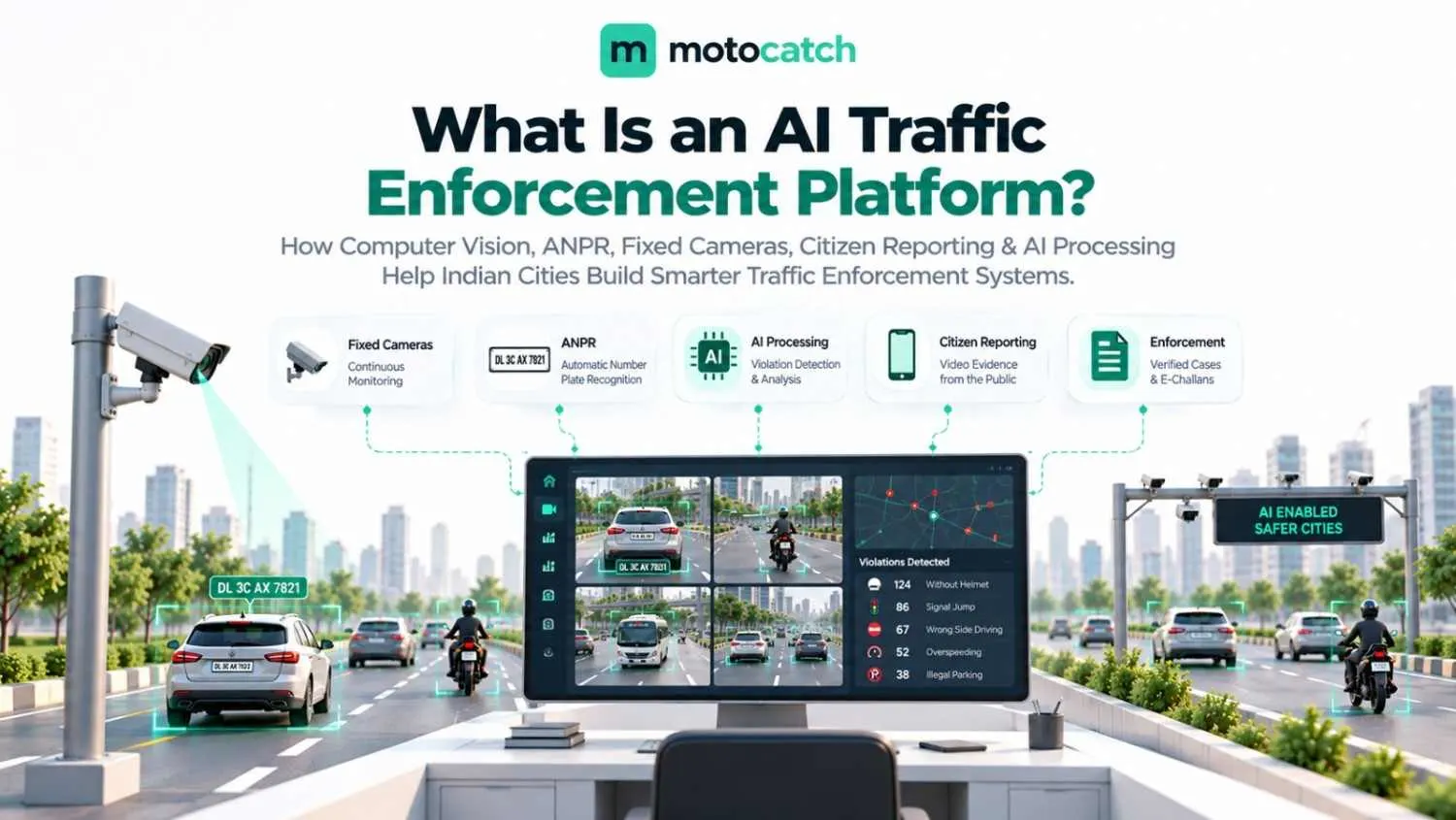
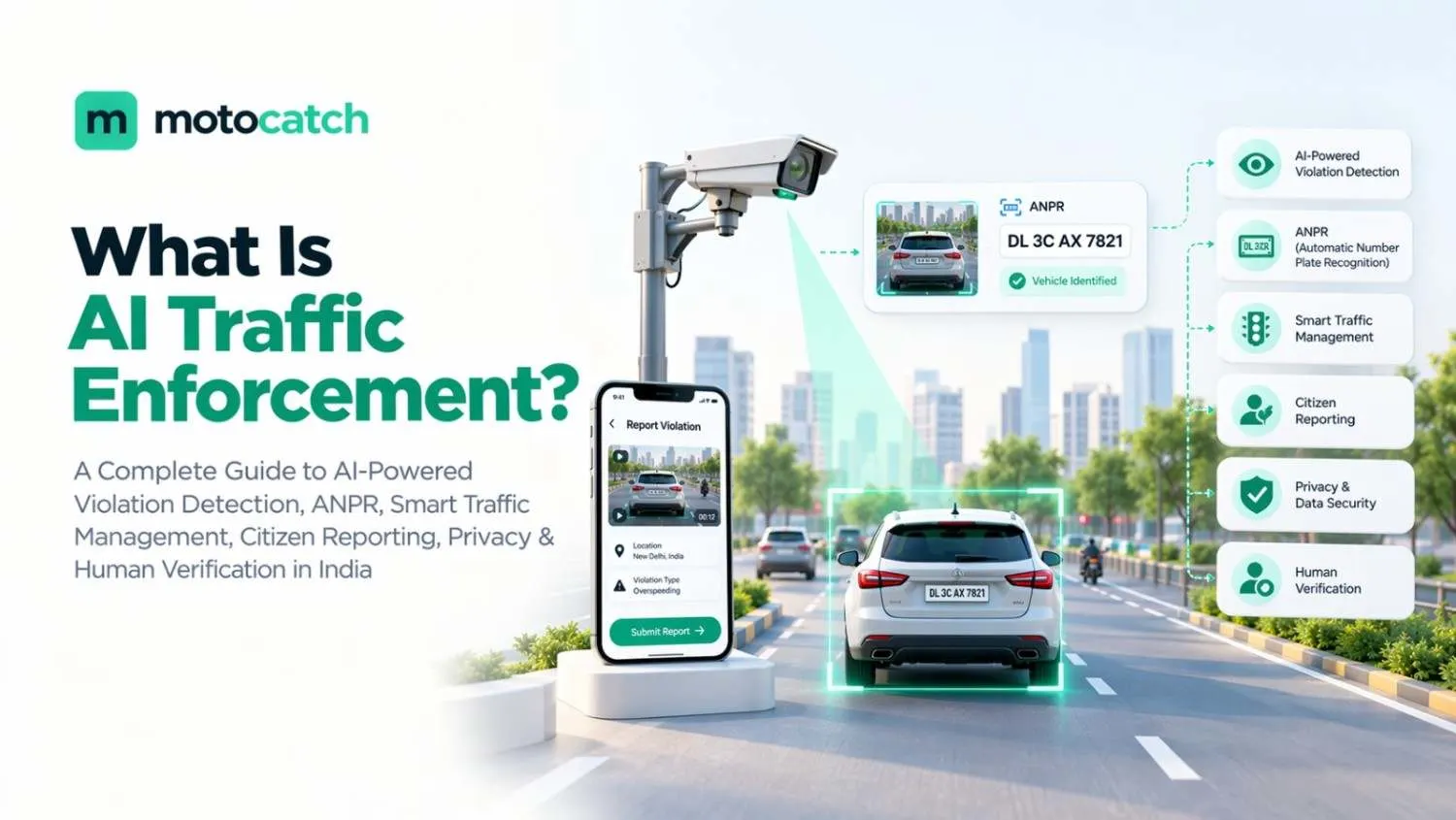
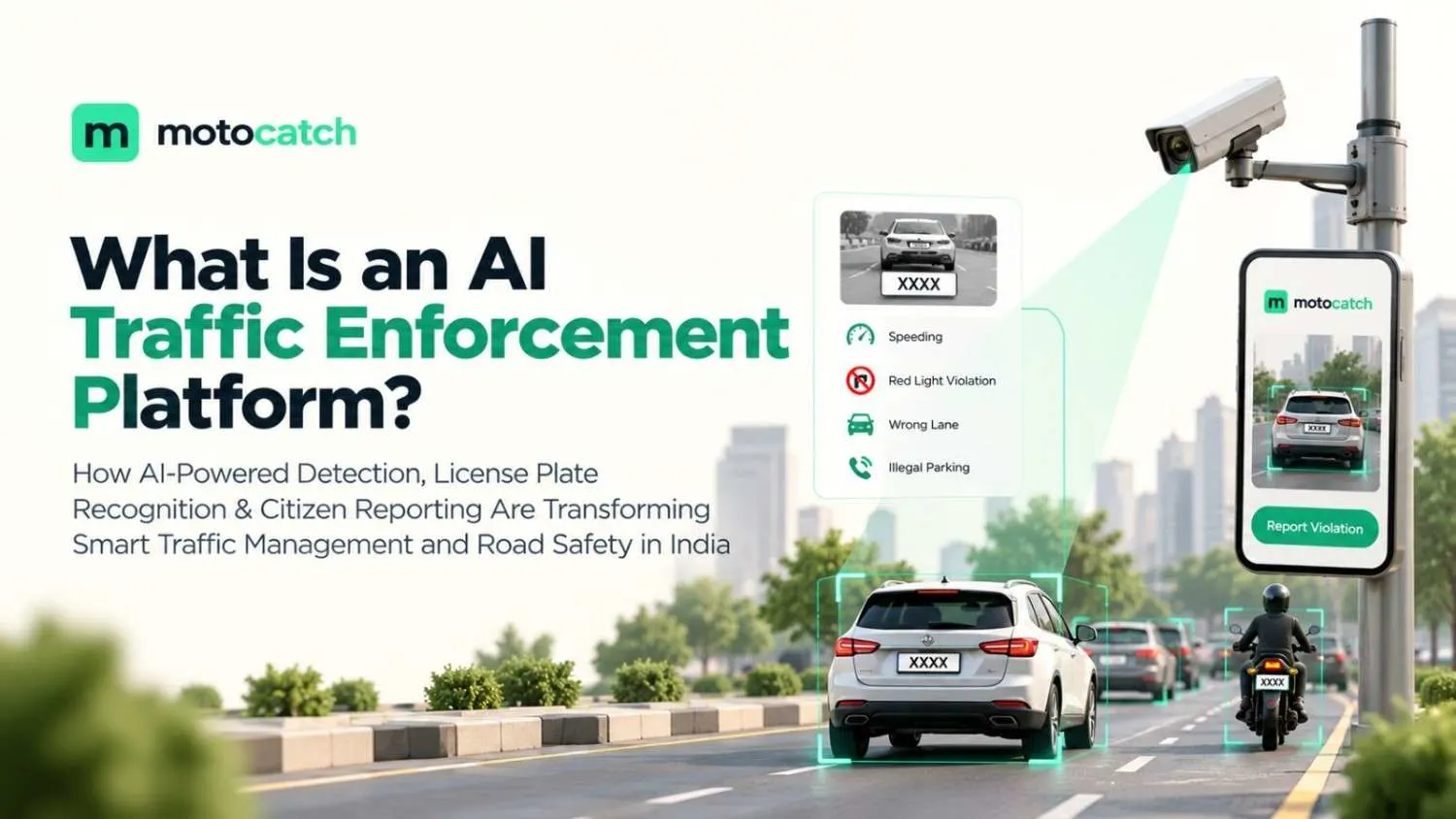
An AI traffic enforcement platform is an integrated system that uses computer vision and machine learning to assist in identifying potential traffic violations, organising relevant footage and evidence, and supporting enforcement workflows — for both enforcement teams and the citizens who witness violations on the road.
The key word is assists. AI in traffic enforcement helps detect and flag potential violations for review. It does not independently make final enforcement decisions. Whether a challan is issued, and on what basis, remains a human decision made by the appropriate traffic authority.
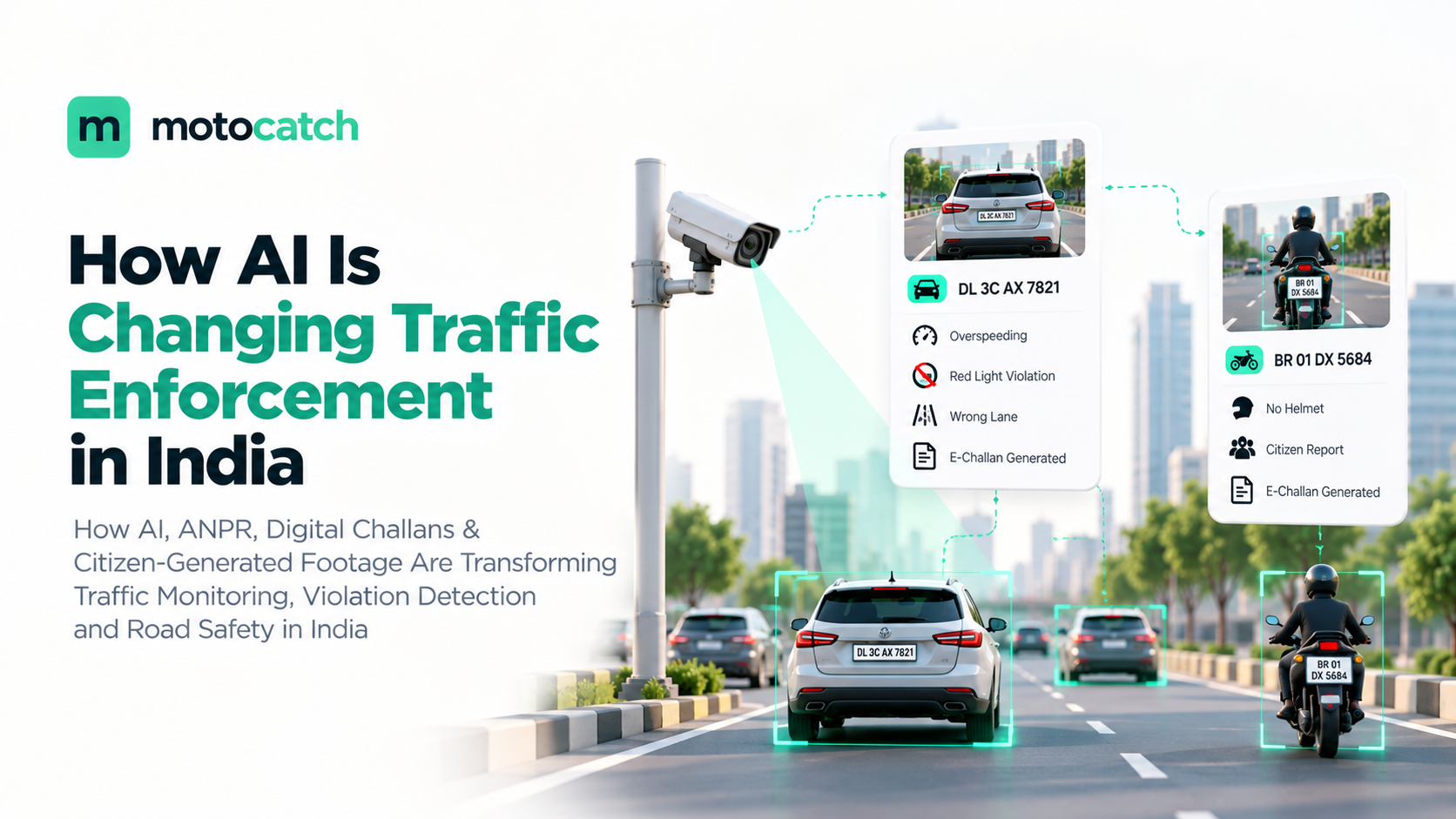
At the infrastructure level, these platforms connect cameras to processing systems that can identify potential violations in real time — a vehicle crossing a stop line, a rider without a helmet, a vehicle exceeding a speed threshold. At the citizen level, they give ordinary people a structured way to document what they observe and submit it for review.
The global AI traffic enforcement camera market was valued at $1.85 billion in 2025 and is projected to reach $5.34 billion by 2034. North America holds the largest share at 36% of revenue, while Asia Pacific is the fastest-growing region at 14.8% a year, driven by large national camera programs and AI detection of offences such as phone and seatbelt use. Countries like India are adding a large base of video enforcement cameras on urban roads and highways, reflecting how seriously the country is taking the scale of its road safety challenge.
How AI Reads License Plates
Automatic Number Plate Recognition — ANPR — is the component that links a captured vehicle image to a registration record. When a potential violation is flagged by the computer vision layer, ANPR attempts to read the vehicle’s registration plate from the footage, which can then be cross-referenced against vehicle registration databases by enforcement authorities.
Modern ANPR systems use deep learning models to read registration plates across India’s varied state plate formats, in different lighting conditions, at highway speeds, and on vehicles moving at angles to the camera.
The challenge specific to India is real. In densely packed traffic, the predicted boxes of distinct objects naturally exhibit high overlap, making it difficult to distinguish true overlaps from false overlaps, particularly for two-wheelers. Systems trained specifically on Indian road conditions, using datasets like the India Driving Dataset (IDD) rather than Western benchmarks, perform meaningfully better at handling the unstructured traffic environments most common across Indian roads.
ANPR assists the identification process. Plate reads are submitted alongside footage for human review by enforcement authorities, who make the determination on appropriate action.
AI vs Manual Traffic Monitoring: What the Difference Means in Practice
Understanding the gap between AI-assisted traffic enforcement and traditional manual monitoring helps explain why technology has become part of the conversation — not to replace officers, but to extend what they can see and review.
A traffic officer at an intersection watches one area with human attention. They act on violations they observe directly. They work defined shifts. AI-powered enforcement systems detect potential violations in real time and send relevant data to the server for further action, without the constraints around attention, shift hours, or physical coverage area.
AI-assisted systems can process footage from multiple camera feeds simultaneously, flag potential violations for officer review, and organise the relevant evidence — plate reads, timestamps, footage clips — in a format that makes enforcement workflows faster and more structured.
The result is not automatic enforcement. It is better-organised information that helps enforcement teams work more effectively through the volume of violations that happen daily across a city’s road network.
Smart Traffic Systems: Adoption in India
Smart traffic management in India has moved from pilot to embedded infrastructure across a growing number of cities and highway corridors.
Across cities such as Ahmedabad, Jabalpur, Ranchi, Nagpur, Visakhapatnam, Satna, and Pimpri Chinchwad, AI has moved past the pilot stage and now sits inside everyday municipal enforcement.
In Chandigarh, AI-enabled cameras connected to the Integrated Command and Control Centre (ICCC) streamlined traffic enforcement and enhanced emergency response coordination. Pimpri Chinchwad has deployed over 600 surveillance cameras across 100 junctions for AI-led traffic and intrusion detection.
In Kerala, AI-powered enforcement systems are deployed across 675 locations. The system uses cameras powered by solar energy and 4G LTE technology to assist in detecting violations in real time and informing drivers through different media.
India’s Smart Cities Mission now includes over 100 cities with operational Integrated Command and Control Centres — deployment sites for automated traffic enforcement systems that support city-wide monitoring from centralised operations rooms.
Local media and citizen feedback from early deployments highlight increased trust in traffic authorities and improved road discipline as direct outcomes of transparent AI enforcement.
Closing Blind Spots Beyond Fixed Camera Coverage
Fixed camera infrastructure covers high-priority intersections and major corridors. It does not cover every road in a city, every rural highway, or every residential street where dangerous driving happens regularly.
Citizen reporting can help extend traffic monitoring beyond fixed camera locations. Read more about how citizen reporting can support safer roads through digital reporting platforms.
A 2023 pilot in Bengaluru, conducted by the Indian Institute of Science (IISc) in partnership with the city’s traffic police, demonstrated that citizen-reported data via AI-enabled apps led to a 30% faster response to road obstructions and accidents.
When citizens capture footage of a potential violation — a reckless overtake, a vehicle going the wrong way, dangerous behaviour at an unmanned junction — that evidence can be submitted for review through platforms designed to organise and route it appropriately. The value is not in replacing camera infrastructure but in extending coverage to the roads and moments that fixed systems do not reach.
Future Trends in AI Traffic Enforcement
The current generation of AI traffic enforcement platforms is producing measurable results. The next phase involves several developments worth watching.
Edge AI reducing infrastructure dependency. Processing footage locally at the camera — rather than routing everything to centralised servers — reduces bandwidth requirements and extends AI-assisted enforcement capability to areas with limited connectivity, including tier-2 cities and rural highways.
Predictive approaches to road safety. Projects like iRASTE — Intelligent Solutions for Road Safety through Technology and Engineering — are using AI not just to assist with violation detection after the fact, but to identify high-risk road segments and time periods where interventions can reduce accident probability before incidents occur.
Better models for Indian road conditions. Models trained on Western benchmarks perform poorly in unstructured Indian traffic conditions. The development of AI trained specifically on India-specific datasets is producing meaningfully better detection accuracy for the violations and vehicle types most relevant to Indian roads.
Deeper citizen-authority integration. As platforms for citizen reporting mature, the workflow between citizen-submitted evidence and enforcement authority review is becoming more structured. AI-assisted processing of citizen footage — organising plate information, timestamps, and violation classification for human review — makes that workflow more reliable and scalable than unstructured social media submissions.
Where MotoCatch Fits
MotoCatch operates across two distinct products designed for different users and different roles in the road safety ecosystem.
The MotoCatch Citizen App — AI Witness in Every Pocket — is built for ordinary road users who observe a potential traffic violation and want to document and report it. The app helps citizens capture footage, assists in organising the relevant information, and supports submission for review. It is accessible, straightforward, and designed for anyone — not for enforcement personnel.
What the Citizen App does not do is guarantee a challan will be issued after every report. AI assists with footage processing and helps identify potential violations. Whether enforcement action follows is determined by the appropriate traffic authority reviewing the submitted evidence.
The MotoCatch Police App — AI-Assisted Enforcement, On Every Patrol — is designed for traffic police and enforcement teams. It helps officers record potential violations in the field, process footage more quickly, and work through enforcement workflows with AI assistance.
It is a professional tool for enforcement personnel, with a distinct interface and function from the citizen-facing product. Together, the two products address the coverage gap from both directions: fixed infrastructure and enforcement officers cover the roads they can reach, while citizens with the Citizen App can document what they observe on roads that are not covered.
Conclusion
An AI traffic enforcement platform is not a system that independently enforces the law. It is a system that assists detection, organises evidence, and supports the humans — both citizens and enforcement personnel — who are responsible for road safety.
India’s adoption of AI-powered traffic enforcement is accelerating across its cities and highways. The results from early deployments show meaningful improvements in violation detection, enforcement workflow efficiency, and road discipline. More cities are embedding AI assistance into their enforcement architecture. More citizens have the tools to document what they witness and submit it in a form that can be acted on.
The road safety challenge is well-documented and serious. The technology to help address it systematically is available and improving. The role every road user can play — by capturing and reporting what they observe — is a meaningful part of how that gap between violations and enforcement gets narrowed.