A traffic violation can happen in a matter of seconds.
A driver jumps a red light. A motorcyclist rides without a helmet. Someone drives against traffic or uses a phone while behind the wheel. These incidents may seem routine, but each one can put other road users at risk.
The challenge is not always noticing a violation. The bigger problem is reporting it quickly and correctly while the incident is still clear and the evidence is useful.
Traffic authorities cannot be present on every road at every moment. This is where traffic violation reporting can give citizens a more active role in road safety. With digital reporting platforms, people can safely share photographs, videos, and relevant incident details, creating an additional source of information for traffic authorities.
But citizen reporting has another challenge: the process needs to be simple enough for people to actually use.
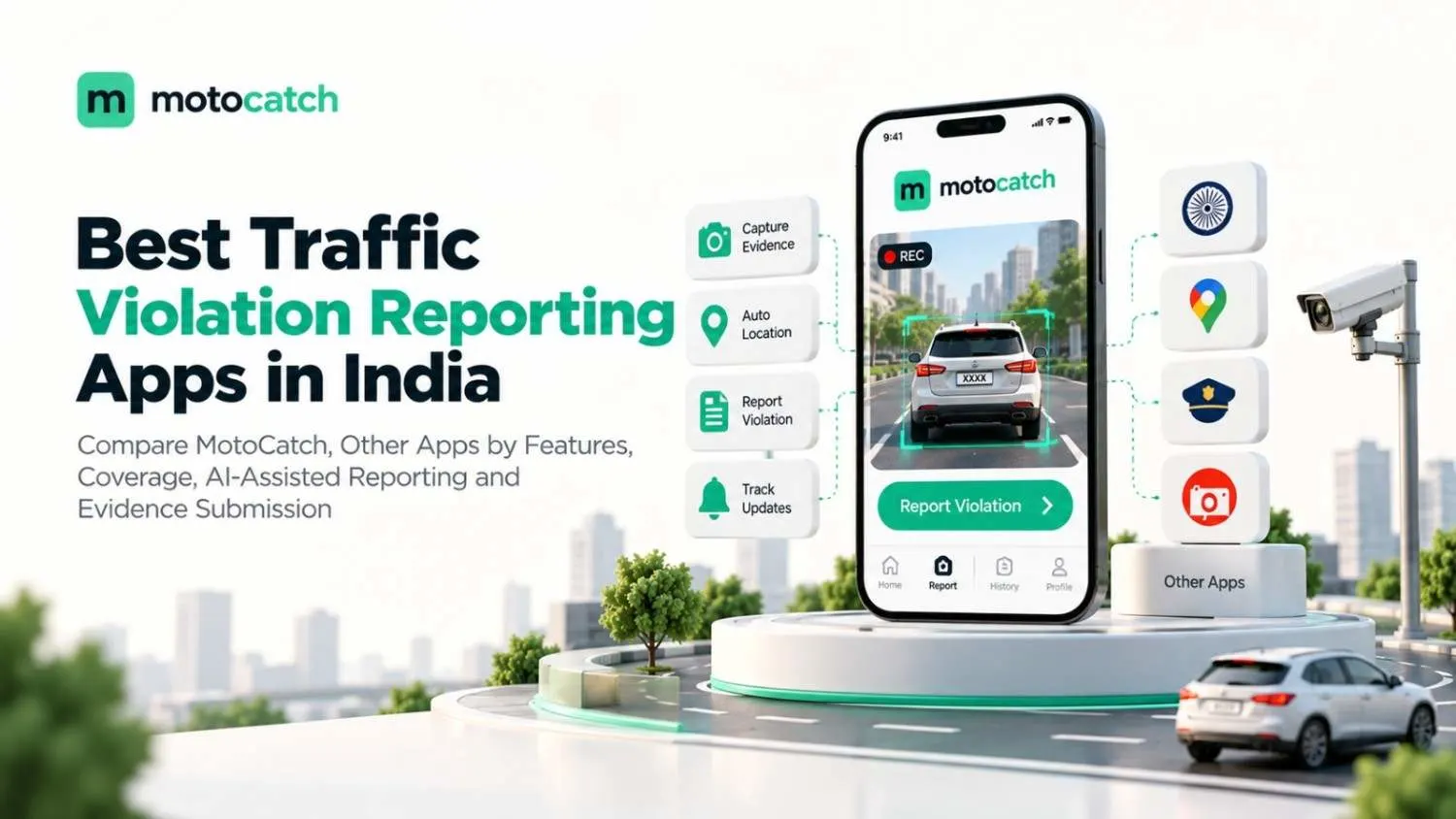
That is where AI-powered solutions such as MotoCatch.ai are exploring a new approach—using computer vision and AI to reduce the manual effort involved in turning road footage into useful evidence.
What Is Traffic Violation Reporting?
Traffic violation reporting is the process of submitting information or evidence about a suspected traffic violation to the appropriate traffic authority.
Depending on the platform and jurisdiction, a report may include:
| Information | Why it matters |
|---|---|
| Photo or video | Provides visual evidence |
| Vehicle number | Helps identify the vehicle |
| Location | Establishes where it occurred |
| Date and time | Provides context for verification |
| Violation type | Helps categorise the incident |
The process is not about citizens deciding whether someone is guilty. The purpose is to provide information that authorities can review and verify.
Traffic violations can range from red-light jumping and wrong-side driving to dangerous driving, riding without a helmet or seat belt, and using a mobile phone while driving. These incidents may happen within seconds, making timely and reliable reporting difficult.
Why Does Citizen Traffic Reporting Matter?
Traditional traffic enforcement relies on traffic police, surveillance cameras, automated systems, and other monitoring mechanisms. These systems are important, but they cannot provide complete visibility across every road at every moment.
Fixed cameras monitor specific locations, while police presence is also limited by time, location, and available resources.
Citizens, on the other hand, are already present across the road network. They may see violations happen in real time and, when it is safe to do so, capture evidence that would otherwise never reach the authorities.
This is the basic value of citizen traffic reporting.
It does not replace traffic police or existing enforcement systems. Instead, citizen traffic reporting can complement them by providing an additional way to document road violations and share relevant evidence.
How to Report a Traffic Violation Online
If you are wondering how to report a traffic violation online, the first thing to know is that the process varies by location. Different traffic authorities have different platforms, eligible violations, and evidence requirements. For a step-by-step guide specific to India, read how to report a traffic violation in India.
However, the basic process generally follows four steps.
1. Identify the violation
First, determine what happened.
It could be:
• Red-light jumping
• Wrong-side driving
• Dangerous driving
• Driving without a helmet
• Seat-belt violation
• Triple riding
• Mobile-phone use while driving
• Other violations supported by the local reporting system
Only report incidents that can reasonably be established from the evidence.
2. Report Safely
Do not put yourself or anyone else at risk to record a traffic violation.
Drivers should never use their phones while driving. If possible, pull over safely, ask a passenger to record the incident, or use a dashcam that records automatically.
3. Capture the incident
If the situation can be recorded without creating a safety risk, capture clear evidence of what happened.
This point is critical: never put yourself or someone else in danger just to record a violation.
A passenger or safely positioned bystander may be able to record the incident instead.
4. Collect relevant details and submit the report
The reporting platform may ask for information such as:
• Vehicle registration number
• Date and time
• Location
• Violation category
• Photo or video
Finally, submit the information through the appropriate official website, app, or reporting channel.
The report then moves from the citizen to the relevant authority for review.
Why Reporting With Video Can Be More Useful
A photograph can capture a moment. Video can capture an event.
That difference matters when the violation involves movement.
For example, consider a vehicle approaching a traffic signal. A photograph may capture the vehicle at a particular moment, but a video can provide more context by showing the sequence of events leading up to the violation.
Video can be particularly useful for incidents such as:
• Red-light jumping
• Dangerous driving
• Wrong-side driving
• Sudden unsafe manoeuvres
• Mobile-phone use while driving
However, the quality of the evidence still matters. A long or unclear video is not necessarily more useful than a short, focused recording that clearly captures the incident.
The goal is useful evidence, not simply more footage.
What Happens After Reporting a Traffic Violation?
Many people assume that once they submit a report, a challan is automatically generated.
That is not necessarily the case.
The report generally needs to go through a review or verification process, and the exact workflow depends on the relevant traffic authority.
A simplified version looks like this:
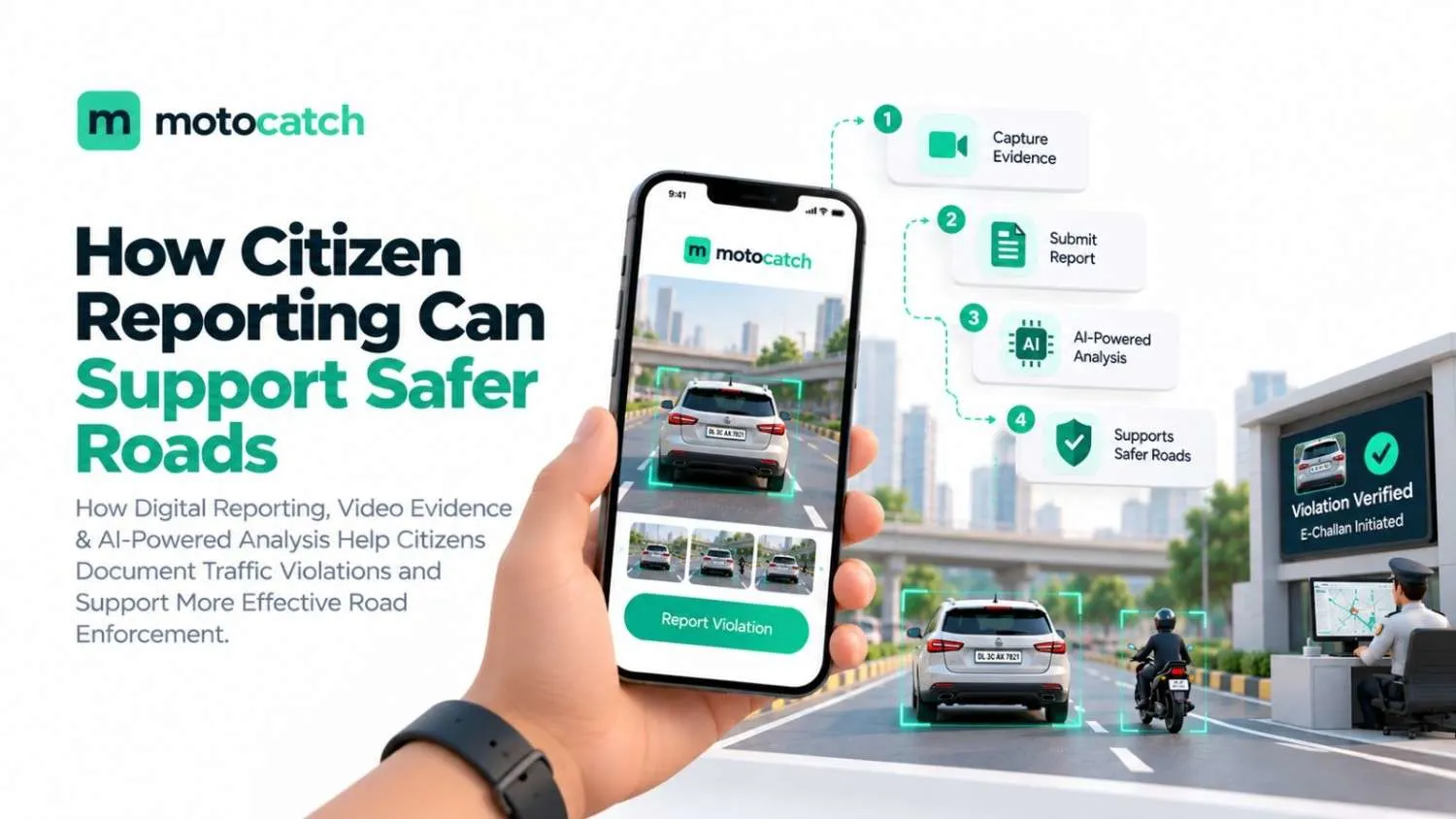
Citizen submits evidence → Authority reviews it → Incident is verified → Appropriate action is considered
A citizen report is an input—not the final enforcement decision.
The Problem With Manual Traffic Violation Reporting
The idea behind citizen reporting is simple, but the actual process can involve several steps.
Imagine witnessing a traffic violation that lasts only five seconds. To report it, you may need to:
- Record the incident.
- Identify the vehicle.
- Read the number plate.
- Determine the violation category.
- Enter the date and location.
- Upload the evidence.
- Submit the report.
That is a lot to ask from someone who is simply trying to help.
The challenge becomes even greater when the incident happens quickly, the number plate is difficult to read, or the person reporting has to manually enter information that could potentially be extracted from the footage.
This creates friction between seeing a violation and successfully reporting it.
Traditional Reporting vs. MotoCatch-Assisted Reporting
| Traditional Reporting | MotoCatch-Assisted Reporting |
|---|---|
| Citizen captures footage | Citizen captures footage |
| Citizen identifies vehicle | AI analyses the footage |
| Citizen reads number plate | AI helps identify the vehicle/number plate |
| Citizen determines violation | AI analyses the potential violation |
| Citizen enters multiple details | Relevant information can be structured |
| Citizen uploads evidence | Evidence is organized for review |
| Citizen submits report | Report is prepared for reporting |
The goal is not to remove the citizen or authority from the process. It is to reduce unnecessary manual effort between capturing an incident and creating a structured report.
How AI Can Simplify Traffic Violation Reporting
MotoCatch.ai uses AI to analyse road footage, identify relevant vehicle and violation information, and help turn the incident into a structured report.
Here is how MotoCatch works in four key stages:
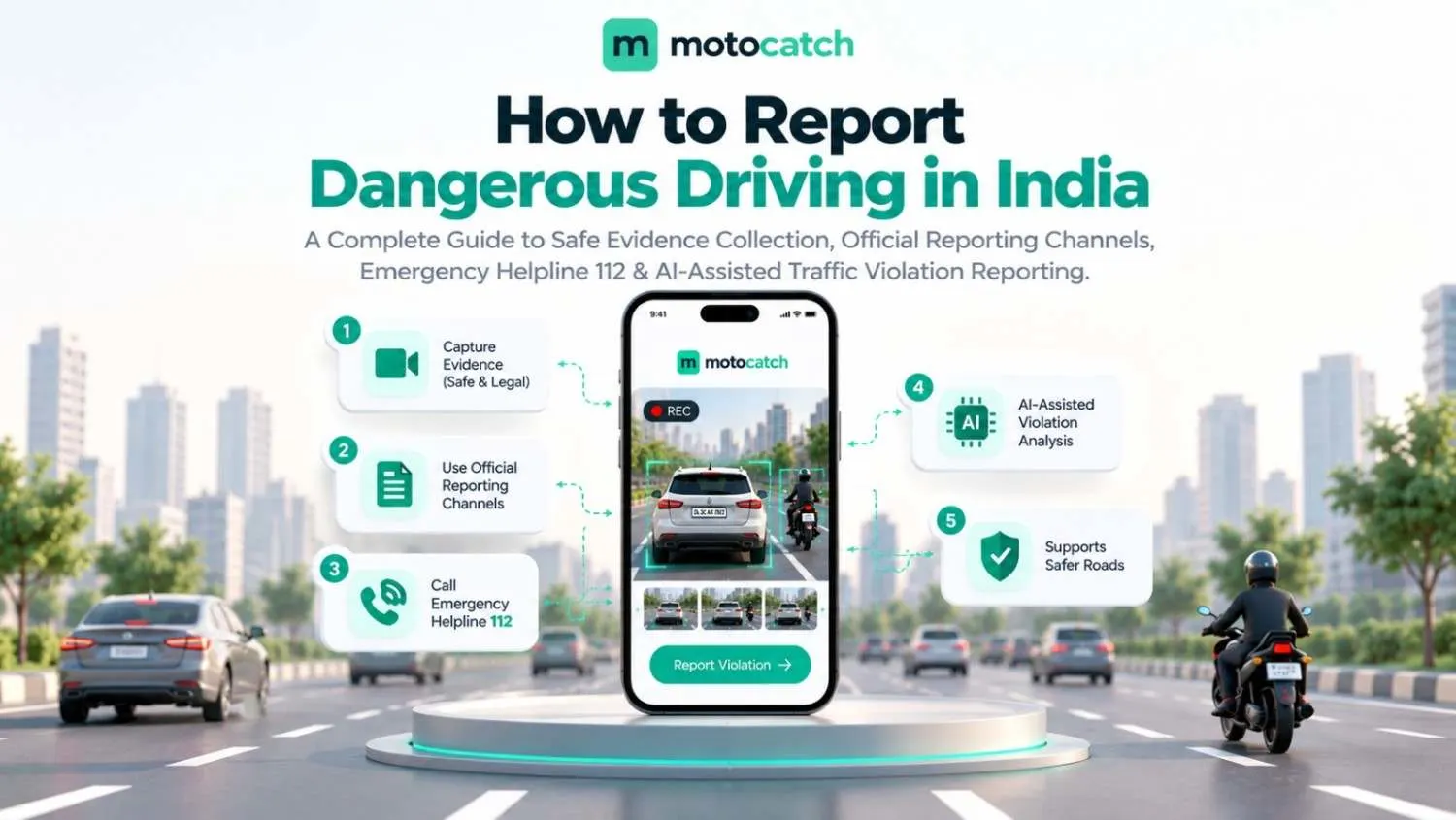
Capture → AI Analysis → Review/Confirmation → Report
Capture
The citizen captures the traffic incident safely through a photo or video.
AI Analysis
MotoCatch analyses the footage to identify relevant details such as the vehicle, number plate, and potential violation.
Review/Confirmation
The information identified from the footage can be reviewed and confirmed before the report is submitted.
Report
The confirmed information is structured into a report for submission through the appropriate reporting process.
The important distinction is that AI does not replace the citizen or the traffic authority.
The citizen captures what happened.
AI helps analyse it.
The information is reviewed and confirmed.
The report is then submitted for authority review.
Why AI-Based Reporting Is Not as Simple as It Sounds
Roads are unpredictable environments.
An AI system may encounter:
• Motion blur
• Poor lighting
• Obstructed number plates
• Multiple vehicles in the same frame
• Heavy traffic
• Different road conditions
• Rain, dust, or glare
• Unclear traffic signals
This makes real-world traffic detection significantly more challenging than identifying objects in controlled datasets.
For a system supporting traffic enforcement, accuracy and context matter. A vehicle must not simply be detected; the system needs to understand what is happening around it.
That is why AI-assisted reporting should be viewed as a way to support evidence collection and organization, while appropriate human or authority-led verification remains important.
Traffic Violation Reporting App: What Should It Make Easier?
A good traffic violation reporting app should not simply digitise a paper form.
It should reduce friction.
For citizens, the ideal experience is relatively straightforward:
Capture → Understand → Report
The technology should help minimize unnecessary data entry and make it easier to provide relevant evidence.
That means the focus should be on questions such as:
• Can the incident be captured quickly?
• Can the relevant vehicle be identified?
• Can the potential violation be detected?
• Can the evidence be organized clearly?
• Can the report reach the appropriate channel?
• Can the process remain safe for the citizen?
The more effort required at each stage, the greater the chance that a potential report is abandoned.
The Role of MotoCatch.ai
MotoCatch.ai is approaching traffic safety from the perspective that citizens are already witnessing road violations. The challenge is making it easier for those observations to become actionable information.
Its AI-powered approach focuses on analysing road footage and helping identify relevant details such as the vehicle and potential violation.
This creates an interesting shift in the role of technology.
Instead of simply giving citizens another form to fill out, technology can help interpret what they have already captured.
The broader idea is not “report more violations at any cost.”
It is:
Make responsible reporting easier, while improving the quality and usefulness of the information being submitted.
From Citizen Reports to Road Intelligence
Citizen reports can provide more than individual incident records. When structured and reviewed consistently, they can contribute to a broader understanding of what is happening across the road network.
MotoCatch can help transform citizen-captured footage into structured information that can be reviewed and used within the appropriate enforcement process.
The focus is not simply on collecting more reports. It is on turning road-level observations into useful information while keeping verification and enforcement with the relevant authorities.
From Citizen Reporting to Citizen Participation
There is a larger idea behind digital traffic reporting.
Road safety is often discussed as the responsibility of governments, traffic police, and vehicle manufacturers. But everyday road behaviour involves everyone who uses the road.
That makes citizens part of the equation.
When technology allows people to safely report what they witness, they can contribute to a wider road-safety ecosystem. AI can help process the information, while authorities remain responsible for verification and enforcement.
This combination can create a more distributed approach to road visibility.
Instead of relying entirely on fixed points of observation, cities can benefit from information coming from the people who are already moving through them.
What Could the Future Look Like?
The future of road safety will likely involve several technologies working together rather than one system doing everything.
Traffic police can handle direct enforcement and verification. Cameras can provide continuous monitoring at fixed locations. AI can assist with detection and analysis, while digital reporting can make incident submission easier.
Citizen reporting can provide information from places that may not have dedicated monitoring.
The opportunity is to make these different layers work together more effectively.
Conclusion
Traffic violation reporting is evolving from a largely manual activity into a more digital and technology-assisted process.
Citizens can provide an additional layer of visibility. Video can provide context. AI can help identify vehicles and potential violations. Digital platforms can make submission easier. Authorities can then review and verify the evidence through the appropriate enforcement process.
The biggest opportunity may be reducing the gap between seeing a violation and being able to report it effectively.
That is the problem MotoCatch.ai is working to address.
By combining citizen participation with AI-powered analysis, the platform is exploring a model where people can capture what they see while technology helps transform that footage into structured information.
Because safer roads are not created only by catching violations.
They are created when better visibility, responsible reporting, effective technology, and enforcement work together.