Traffic violations such as red-light jumping, dangerous driving, riding without a helmet, and using a mobile phone while driving can put road users at risk. Reporting these incidents through appropriate channels can help traffic authorities identify potential violations and take action where warranted.
Citizens in India may be able to report certain incidents through traffic police apps, state police portals, or designated online reporting systems. Some tools can also help citizens organise recorded footage and relevant details before submitting a report.
Understanding how to use a traffic violation app, capture evidence responsibly, and submit a report through the appropriate channel can help citizens contribute to safer roads.
This guide focuses on the practical reporting process: choosing the right official channel, capturing evidence safely, submitting accurate details, and following up where possible.
What Is a Traffic Violation App?
A traffic violation app is a mobile application that helps users report or document certain traffic violations or access traffic-related services. The available features depend on the application and its intended purpose.
Some applications allow citizens to submit photographs or videos of observed violations through designated reporting procedures. Others provide services such as checking challans, paying penalties, or accessing police and transport information.
It is important to distinguish between three types of digital services:
Traffic violation reporting apps: Help citizens report specified violations through designated procedures.
Traffic police portals: Provide state-specific police services, which may include traffic complaint submission.
Challan portals: Primarily provide services such as checking challan information and paying penalties.
Not every traffic-related app supports citizen reporting. Users should verify an application's official listing, available features, and reporting instructions before submitting evidence.
MotoCatch AI: An AI-Assisted Traffic Violation Reporting Solution
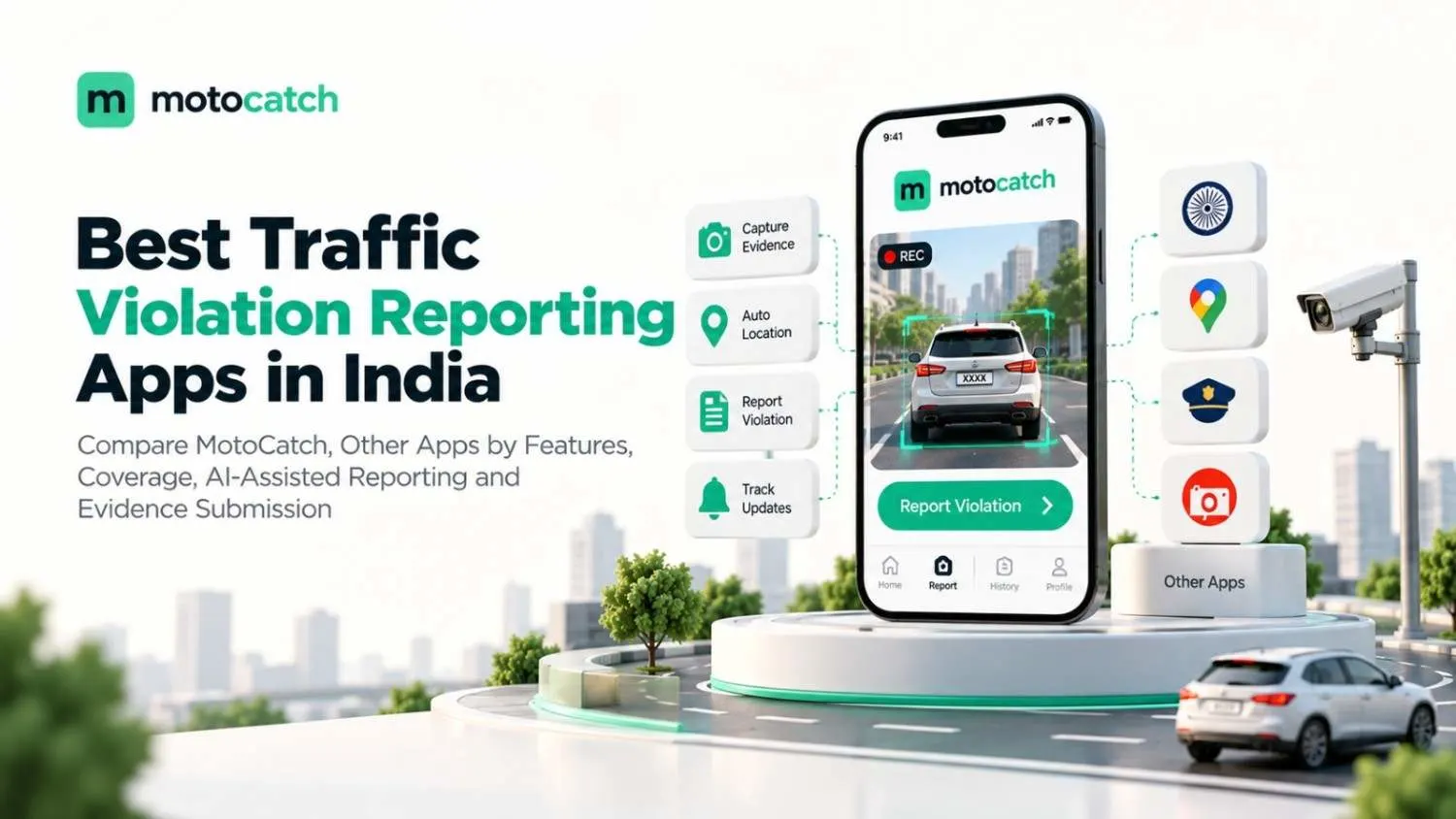
MotoCatch AI is an intelligent mobility application designed to help citizens capture and report observed traffic violations.
Its AI-assisted capabilities support the processing and review of captured traffic footage, helping organise relevant information for reporting. Where the available evidence permits, AI-assisted processing and optical character recognition (OCR) can help identify potential violations and read vehicle registration numbers.
MotoCatch's performance depends on real-world conditions. Moving vehicles, partially visible number plates, poor lighting and patchy network connectivity can affect processing accuracy and reliability.
The application supports the preparation and organisation of information. AI does not independently make final enforcement decisions or issue challans. The appropriate authority remains responsible for verifying evidence and deciding whether enforcement action is warranted.
Find the Right Reporting Channel
Citizen-reporting options vary by state and city. Use the following services to identify a suitable channel, then confirm the current reporting instructions on the official website or app.
1. MotoCatch AI
MotoCatch AI supports the processing of smartphone-recorded footage and helps organise relevant information for reporting and review. Its current workflow and submission options should be checked in the official app listing and instructions.
Processing results depend on footage quality and operating conditions. Review extracted details where possible; the relevant authority remains responsible for verification and enforcement decisions.
2. Traffic Prahari — Delhi
Delhi Traffic Police operates the Traffic Prahari programme, which allows registered citizens to report specified traffic violations using photographs or videos.
The programme covers designated violation categories, including wrong-side driving, triple riding, riding without a helmet, red-light jumping, and using a mobile phone while driving. Accepted evidence and reporting requirements depend on the applicable category.
Citizens can review the programme details on the official Delhi Traffic Police Traffic Prahari page.
Traffic Prahari is a Delhi-specific programme. Citizens in other states should consult their local traffic police services rather than assume the same application or reporting process applies nationwide.
3. State Traffic Police Apps and Websites
Some states and cities provide dedicated traffic police applications or online reporting facilities. The available services differ by jurisdiction.
To find the appropriate channel:
Visit your state or city's official police or traffic police website.
Look for citizen services, traffic complaints, or violation-reporting options.
Read the reporting instructions and evidence requirements.
Confirm whether the service accepts reports from members of the public.
Follow the official submission procedure.
The Ministry of Home Affairs' Digital Police portal provides access to state police citizen portals. However, it does not guarantee that every state offers a dedicated traffic-violation reporting facility through that portal.
4. Digital Police Portal
The Digital Police portal connects citizens with police-related services and state police citizen portals.
Depending on the state, citizens may find complaint registration and other police services through the linked systems.
Visit the official Digital Police portal and select the relevant state or service.
Do not assume that the portal accepts every type of traffic-violation report. Confirm the available services on the relevant state police website before proceeding.
5. eChallan Portal
The national eChallan portal primarily provides traffic challan services, including checking challan information and making payments where supported.
It should not be confused with a citizen-reporting application. The existence of an online challan service does not mean that citizens can directly submit photographs or videos of every traffic violation through it.
Use the portal for the services it officially provides, and consult the appropriate traffic police channel when you want to report an incident.
Which Traffic Violations Can Citizens Report?
The violations accepted for citizen reporting depend on the relevant authority's rules. Check the selected platform's accepted categories before submitting a report. Depending on the authority, categories may include:
Red-light jumping
Driving on the wrong side of the road
Dangerous or reckless driving
Riding without a helmet
Triple riding where prohibited
Using a mobile phone while driving
Improper or obscured number plates
Other violations specified by the local authority
A violation being unlawful does not automatically mean that every application accepts reports about it. Check the platform's permitted categories before submitting evidence.
AI-assisted applications can help process recorded footage and organise information about potential violations. However, processing capabilities and accepted reporting procedures are different things. Follow the instructions of the relevant reporting platform or authority.
If an incident presents an immediate danger, do not attempt to intervene or follow the offending vehicle. Contact the appropriate emergency or police service where necessary.
How to Report a Traffic Violation Step by Step
The exact process varies by application and jurisdiction. The following steps provide a general approach to reporting a traffic violation responsibly.
Step 1: Identify the Appropriate Reporting Channel
Find the traffic police app, website, or citizen portal designated for your state or city.
If you are using an AI-assisted application such as MotoCatch, review its available features and instructions for capturing footage and preparing information for reporting.
Check the publisher, official website, and reporting instructions before downloading an app or sharing personal information. Avoid unofficial applications that claim to issue challans or guarantee enforcement action.
Step 2: Capture Evidence Safely
If the platform accepts photographs or videos, capture evidence only when it is safe and lawful to do so.
Where possible, the evidence should show the relevant vehicle, the apparent violation, and enough context to understand what happened.
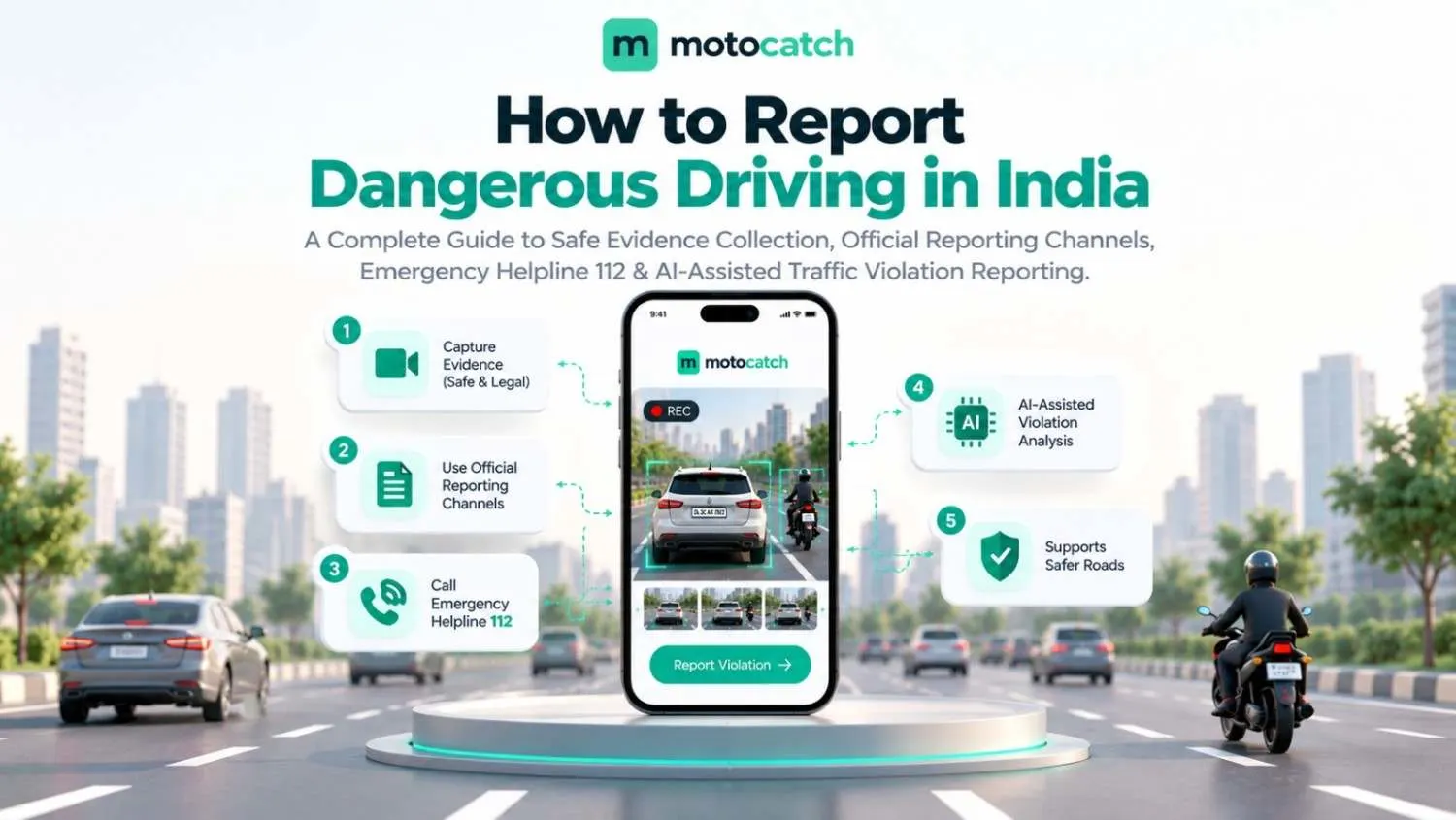
Never use a phone while driving. Do not chase a vehicle, obstruct traffic, or put yourself or others at risk to obtain a recording. If you come across reckless or dangerous driving, knowing how to report it safely is equally important. Our guide on how to report dangerous driving in India safely explains the steps you can take and the precautions to follow.
Step 3: Record the Relevant Details
Depending on the reporting form, you may need to provide:
Vehicle registration number, if visible
Date and approximate time of the incident
Location of the violation
Type of violation
Supporting photograph or video
A short, factual description
Provide only information you can reasonably verify. Avoid guessing the identity of the driver or making claims that the evidence does not support.
Step 4: Process and Organise the Evidence
Some applications can help organise information from captured footage. If you use an AI-assisted tool, review extracted details where possible because lighting, movement, camera angle, number-plate visibility, and network connectivity can affect accuracy.
Step 5: Submit the Report Through the Designated Channel
Follow the application's instructions and review the information before submitting it.
Ensure that the selected violation category matches the incident and that the evidence meets the platform's requirements. Do not edit a recording in a way that changes its meaning or removes relevant context.
If an application helps prepare or organise evidence but does not directly submit reports to the relevant authority, use the official reporting channel specified by that authority.
Step 6: Save the Reference Number
If the platform generates a complaint or reference number, save it for future reference.
Some services may allow users to check complaint status, while others may not provide detailed updates. Follow the procedures specified by the relevant authority.
Step 7: Allow Authorities to Review the Evidence
Submitting a report does not guarantee that a challan will be issued.
The responsible authority may assess the evidence, verify the incident, and determine whether further action is appropriate under the applicable rules.
Avoid submitting duplicate or knowingly false reports.
Is Anonymous Traffic Reporting Legal in India?
Whether a person can report a traffic violation anonymously depends on the reporting platform and the applicable procedure.
Some reporting channels may require registration, a mobile number, or other identifying information. Others may permit limited information to be submitted without requiring the same level of registration.
Do not assume that a traffic violation app offers anonymous reporting unless its official instructions explicitly confirm this.
There is also an important distinction between keeping a reporter's identity confidential and submitting a report without providing identifying details. These are not necessarily the same thing.
Before submitting a report, check:
Whether registration is compulsory
Which personal details are collected
Whether the platform explains how reporter information is handled
Whether anonymous submissions are accepted
Whether follow-up communication requires contact details
The availability of AI-assisted processing does not establish whether a report can be submitted anonymously. Users should verify the privacy and reporting provisions of the specific application or official channel they intend to use.
Use official channels and provide accurate information. Do not use anonymity to submit false allegations, harass other road users, or publish unverified accusations.
If confidentiality is important to you, review the platform's privacy policy or contact the relevant authority for clarification.
What Happens After You Submit a Report?
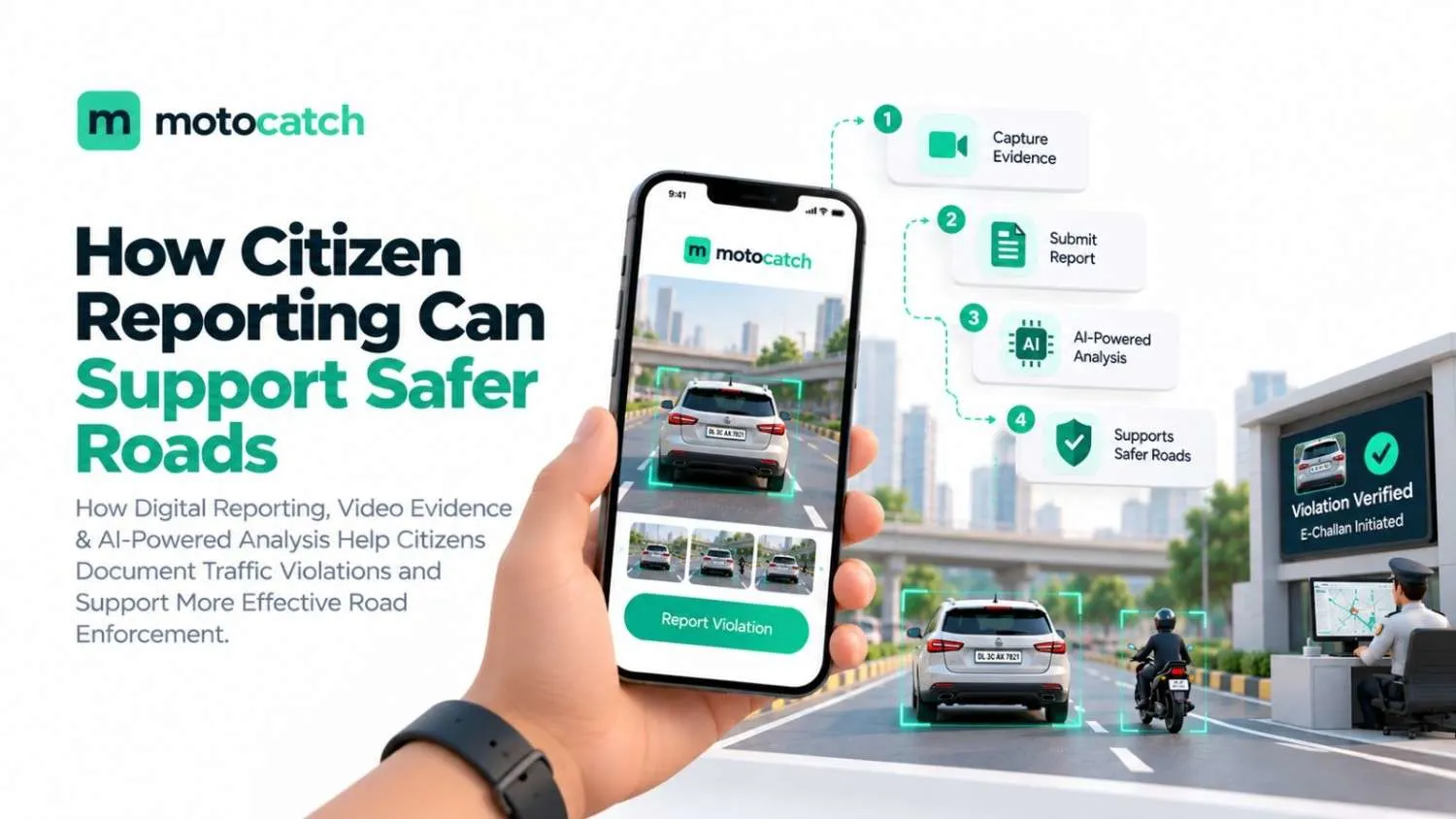
After submission, the relevant authority may review the evidence, verify the incident, and decide whether further action is appropriate under the applicable rules. Some platforms provide a complaint reference number or status updates; others may not.
AI-assisted tools may help organise footage or extract visible number-plate details, but results can be affected by lighting, movement, camera angle, image quality, and partial obstruction. Review extracted details where possible and do not treat automated results as verified evidence.
Citizen-reporting apps are different from automated enforcement systems such as fixed traffic cameras. In either case, the relevant authority and applicable procedure determine whether enforcement action is taken.
Conclusion
A traffic violation app can provide citizens with a practical way to report certain incidents, but the appropriate reporting channel depends on the state, city, and type of violation.
Official traffic police programmes, state police portals, and designated reporting facilities may accept evidence according to their own rules. AI-assisted solutions such as MotoCatch AI can help citizens process smartphone-recorded footage and organise relevant information for reporting and review.
Before submitting a report, verify the application's legitimacy, check whether the relevant violation is accepted, capture evidence safely, and provide accurate information. Anonymous reporting should never be assumed unless the official platform confirms that it is available.
Technology, including AI-assisted processing and automated enforcement systems, can support the handling of traffic-related information. However, processing results require appropriate assessment, and the relevant authority remains responsible for enforcement decisions.
By using suitable tools and official reporting channels responsibly, citizens can contribute to safer roads without putting themselves or others at risk.