India recorded 4,80,583 road accidents in 2023, according to the Ministry of Road Transport and Highways. Behind some of these incidents are traffic violations witnessed by road users — such as dangerous driving, riding without a helmet, or jumping a red light.
That is changing. Across India, a growing number of apps and platforms allow citizens to document and report traffic violations they observe. Some are built by state police departments. Some are built by civic technology organisations. Some bring AI-assisted processing to make citizen-submitted evidence more useful to authorities.
Choosing the best traffic violation reporting app in India depends on your location, the violations a platform accepts, its reporting features, evidence requirements, and how it handles submitted information.
This guide compares the main options available to Indian citizens in 2026, focusing on their features, coverage, and suitability for different users.
Why Citizen Reporting Apps Matter
Traffic enforcement in India operates under a fundamental constraint: there are not enough officers to be present at every location where violations happen. High-risk intersections in major cities get camera coverage and police presence. Rural highways, residential streets, and smaller towns largely do not.
A 2023 pilot in Bengaluru, conducted by the Indian Institute of Science (IISc) in partnership with the city's traffic police, demonstrated that citizen-reported data via AI-enabled apps led to a 30% faster response to road obstructions and accidents.
When citizens can document violations, they observe and submit that evidence in a structured, reviewable format, enforcement coverage extends into the gaps that infrastructure alone cannot fill. That is the value proposition shared by every reporting app on this list — though each one delivers it differently.
What to Compare Before Choosing an App
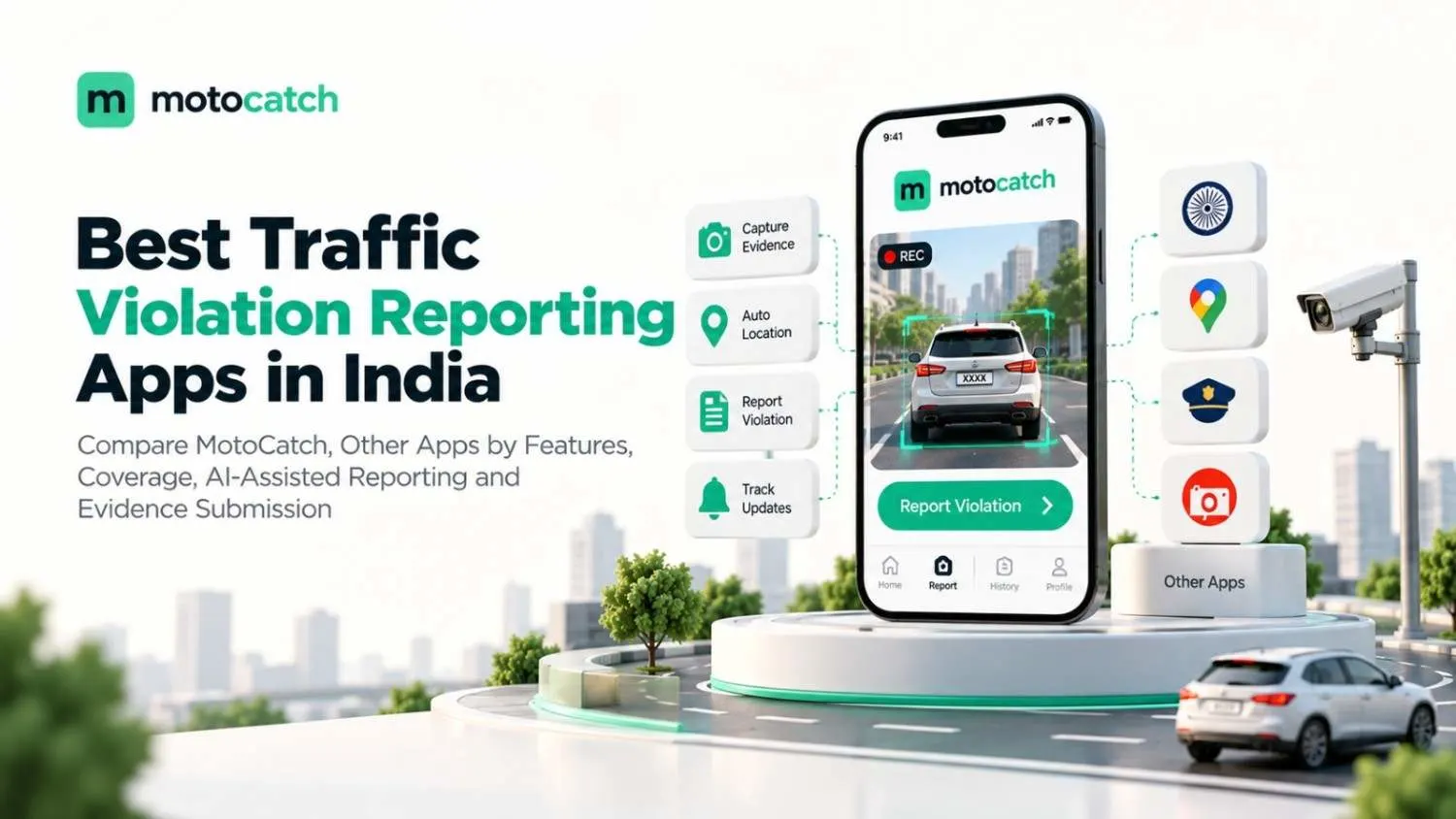
Traffic violation reporting options differ in coverage, supported violation categories, evidence submission, and how information is processed. Some are official state or city services; others help citizens organise evidence before it is submitted for review.
When comparing platforms, look at whether they:
• Accept reports from members of the public
• Operate in your state or city
• Support the violation category you want to report
• Allow photo or video uploads, or require in-app capture
• Offer AI-assisted processing or rely on manual review
• Explain registration, privacy, and evidence requirements
• Clearly state that authorities — not the app — decide whether enforcement action is warranted
These differences matter more than simply whether a service is described as a traffic app. Always check the official listing and current instructions before using a platform.
Top Traffic Violation Reporting Apps in India
MotoCatch — AI Witness in Every Pocket
MotoCatch is a citizen-focused traffic violation reporting platform that brings AI-assisted processing to the evidence citizens capture on their phones.
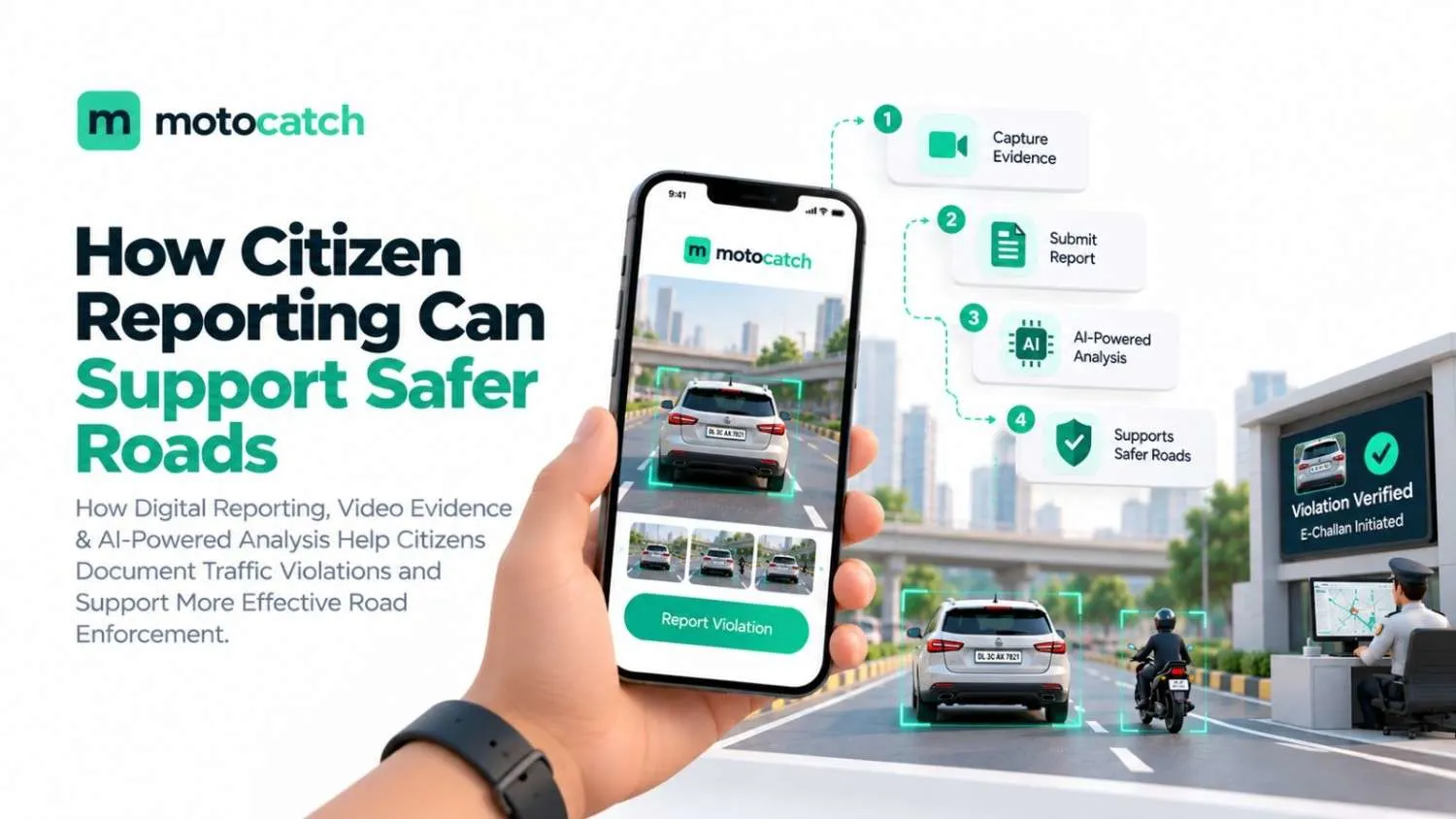
MotoCatch helps citizens capture and report traffic violations from their phone. AI helps identify potential violations and organise relevant information for reporting and review. The platform brings technology and community participation together to encourage awareness among everyday road users.
What distinguishes MotoCatch from most state police apps is the AI processing layer applied to submitted footage. When a citizen captures a potential violation and submits it through the app, AI assists in identifying relevant details — including number plate information, violation classification, and location and timestamp data — and helps organise it into a structured format that is more useful for authority review than a raw photo or video submission.
Important to understand: AI in MotoCatch assists with detection and review. It does not independently make final enforcement decisions or guarantee that every submission results in a challan being issued. Whether enforcement action follows is determined by the appropriate traffic authority reviewing the submitted evidence.
Key characteristics:
• Designed for ordinary citizens — accessible, simple, approachable
• AI-assisted footage processing to help identify potential violations
• Helps process citizen-captured footage from locations that may be beyond fixedcamera coverage; this does not guarantee enforcement coverage
• App availability does not necessarily mean direct reporting to traffic authorities is supported nationwide; users should confirm the supported reporting workflow
MotoCatch is the right choice for citizens who want their submissions to be processed more intelligently than a raw WhatsApp message to a police account, and who want to process citizen-captured footage from roads that may not be covered by fixed enforcement infrastructure. This does not guarantee that the app can submit reports directly to an authority in every location.
Traffic Prahari — Delhi Traffic Police
Traffic Prahari — which translates to Traffic Sentinel — is a mobile application developed by the Delhi Traffic Police. It was relaunched on September 1, 2024, to improve citizen involvement in traffic law enforcement, reviving the earlier Traffic Sentinel Scheme launched in 2015 with advanced technology, GPS tracking, and a reward system.
The official programme describes a points-based reward system for active participants. The current official page does not confirm the specific monthly cash amounts sometimes quoted elsewhere, so those figures are not included here.
False reporting can lead to suspension from the app or legal consequences. The app aligns with the Motor Vehicles Act, Delhi Traffic Police guidelines, and cyber law safeguards.
Key characteristics:
• Delhi-specific — designed for Delhi roads and routed to Delhi Traffic Police
• Points-based reward system; check the official programme page for current details
• GPS tracking of submitted reports
• Requires registration and is accountable — not anonymous
• Reports reviewed and actioned by Delhi Traffic Police
Traffic Prahari is the right choice for Delhi-based citizens who want a direct line to Delhi Traffic Police and the possibility of earning rewards for consistent reporting.
MahaTraffic App — Maharashtra Traffic Police
MahaTrafficapp is for communication between citizens of Maharashtra and Maharashtra traffic authorities. Traffic police send traffic alerts and challan notifications, while citizens send violations and incidents on road with evidence. The app also facilitates viewing traffic education material and payment of traffic challans.
The Google Play listing currently shows over 1 million downloads and a 4.2-star rating. These figures can change; see the MahaTrafficapp Google Play listing for current ratings and reviews. The Apple App Store listing also provides the app description and user reviews.
Key characteristics:
• Maharashtra-specific — covers Mumbai, Pune, Nagpur, and other Maharashtra cities
• Bidirectional communication — police send alerts, citizens send reports
• Also used for challan payment
• No reward system
MahaTraffic is the practical choice for Maharashtra residents who want an official channel for reporting violations in their state.
Mumbai Traffic Police App
The Mumbai Traffic Police App is for communication between citizens of Mumbai and Mumbai traffic authorities. Citizens send violations and incidents on road with evidence, exact date-time and location. The app facilitates viewing traffic education material and payment of traffic challans.
The Google Play listing currently shows a 4.6-star rating and around 15,000 reviews; ratings and review counts may change. Some reviewers have reported unread complaints and requested support for uploading previously captured footage. These are individual user reports, not confirmation that every user will experience the same issue. Check the Mumbai Traffic Police Google Play listing and the Apple App Store listing for current information.
Key characteristics:
• Mumbai-specific
• Strong official integration with Mumbai Traffic Police
• In-app camera required — cannot upload pre-captured footage in the current version
• Also used for challan payment
Mumbai Traffic Police App is the direct official channel for Mumbai residents, though the in app camera limitation is a real usability constraint for capturing fast-moving violations.
Public Eye — Bengaluru Traffic Police
Public Eye is a mobile app developed by Janaagraha's IChangeMyCity platform in collaboration with the Bangalore Traffic Police. The app enables citizens to report traffic violations by uploading photos or videos of vehicles with their number plates. Janaagraha and the app-store listing state that complainants should hear from BTP within 48 hours. See the Janaagraha programme page, Google Play listing, and Apple App Store listing.
Violation categories include no parking, one-way and no entry violations, parking on footpath, riding on footpath, riding without a helmet, defective or fancy number plates, stopping on zebra crossings, triple riding, and signal jumping.
For a violation to be considered valid, the vehicle registration number as well as the violation committed must be visible in the submitted photos. If the complaint does not meet the required validity parameters, it is rejected.
Key characteristics:
• Bengaluru-specific
• Civic tech origin — developed by Janaagraha rather than police directly
• Published 48-hour contact/response expectation; check the official programme information for current terms
• Clear validity criteria — number plate and violation both must be visible
Public Eye is a strong choice for Bengaluru residents who want a civic-tech-backed reporting channel with a defined response time.
PTP Traffic Cop App — Pune Traffic Police
The Pune Traffic Police launched the PTP Traffic Cop App in June 2025, according to contemporaneous reporting. Reported categories include traffic offences, accidents, vehicle breakdowns, potholes, traffic jams, road damage, waterlogging, oil spills, fallen trees, and abandoned vehicles. A launch report quoted police as saying action would be taken within 48 hours after verification; I could not verify this as a current service commitment on an official app listing. See the launch report and check the Pune City Police official website for current information. I could not verify a current official app-store listing, so I have not supplied an unverified download link.
Key characteristics:
• Pune-specific • Broader scope than pure traffic violation reporting — includes road condition reporting
• A 48-hour action timeline was reported at launch; current terms should be confirmed with Pune Traffic Police
• Part of Pune Traffic Police's effort to improve real-time communication with citizens
PTP Traffic Cop is the right choice for Pune residents, particularly those who want to report road conditions and hazards alongside traffic violations.
Key Differences at a Glance
The main differences between the options reviewed above are their geographic coverage, accepted reporting categories, submission workflow, and evidence processing features. MotoCatch helps process citizen-captured footage and organise relevant information. Its availability does not by itself establish that direct submission to a traffic authority is supported nationwide. State and city police apps provide jurisdiction-specific reporting channels, while general police portals and eChallan services may offer different types of services.
AI-assisted processing does not replace evidence verification or guarantee enforcement action. The relevant authority remains responsible for reviewing reports and deciding what action, if any, is appropriate.
Features to Look for in a Traffic Violation Reporting App
Not every app is the right fit for every citizen or every situation. Here is what actually matters when choosing:
Coverage area. State police apps generally serve their respective jurisdictions. For any other app, distinguish between being able to use the app in a location and being able to submit a report directly to the relevant local authority. Confirm the supported reporting workflow before relying on it.
Upload flexibility. Some apps require you to capture footage within the app itself — which is difficult when a violation happens suddenly. Apps that allow you to upload footage you have already captured give you more realistic options in fast-moving situations.
AI assistance. Unprocessed photos and videos submitted without structured metadata create manual review burden. Apps that assist in organising plate information, location, timestamps, and violation classification make submissions more actionable.
Anonymity and privacy. Understand whether the app identifies you to the authority receiving your report, and what the implications are. Some apps require registration under your own identity. Some allow more anonymity. Consider your personal comfort level, particularly if you are concerned about confrontation with a driver you have reported.
Clarity about outcomes. Any responsible reporting app should be clear that not every submission results in enforcement action. Enforcement decisions are made by traffic authorities reviewing submitted evidence — not by the app or its AI processing.
Simplicity. An app that requires too many steps to submit a report will be abandoned midsubmission when a violation happens quickly. The faster the capture and submission flow, the more likely it is to be used consistently.
Conclusion
MotoCatch is bringing a smarter, AI-assisted approach to traffic violation reporting in India. By helping citizens process captured footage, identify potential violations, and organise relevant information, MotoCatch makes it easier to turn everyday road observations into structured information for reporting and review.
Unlike location-specific traffic police apps, MotoCatch focuses on using AI to help process citizen-captured footage, including footage from roads beyond fixed-camera coverage. This offers citizens another way to contribute to road safety through technology and active participation.
With its vision of “AI Witness in Every Pocket,” MotoCatch aims to make road safety a shared responsibility, empowering citizens to play a more active role in identifying and documenting potential traffic violations.
Safer roads start with awareness, and MotoCatch helps turn that awareness into action. While the relevant authorities remain responsible for verifying reports and deciding on enforcement, MotoCatch helps citizens take a meaningful step towards building safer roads.