India recorded 5.13 lakh road accidents in 2025 — an average of 59 every hour. Behind every one of those statistics is a moment where a dangerous driver made a choice that put other people at risk. Overspeeding. Jumping a red light. Weaving between lanes at high speed. Driving while using a phone.
Most of those moments happen without any traffic officer present to catch them. But they often happen in front of someone — a commuter, a pedestrian, a driver in the next lane — who has a phone in their pocket and a clear view of what just happened.
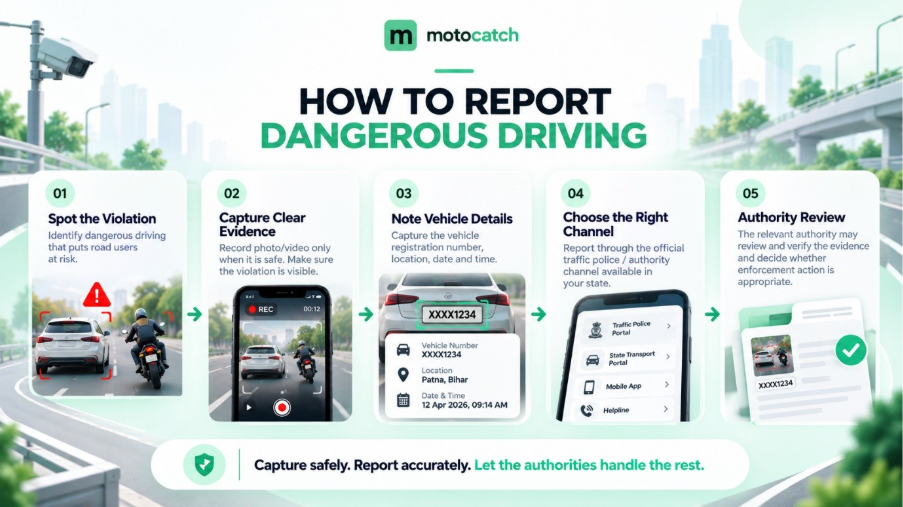
If you witness dangerous driving, the practical steps are simple: stay safe, capture clear evidence only when it is safe to do so, note the vehicle number, location and time, and use the appropriate official reporting channel for your state.
What You Need Before You Report
A useful report needs three things — clear evidence, the vehicle's registration number, and accurate location and time information.
Evidence means a photo or video that clearly shows the violation happening. The number plate should be readable, and the violation itself should be visible — not just the vehicle.
The registration number helps the relevant authority identify the vehicle involved. If the plate cannot be read clearly, it may be difficult for authorities to verify or act on the report.
Location, date, and time provide the context needed to review the incident.
A few practical points:
- Never take photos or video while you are driving. Pull over, ask a passenger, or use a dashcam that records automatically.
- Be factual in your description — "vehicle crossed red light at junction X" rather than anything emotional or interpretive.
- Keep a record of any reference number you receive so you can follow up on the status of your report.
How to Report Dangerous Driving in India
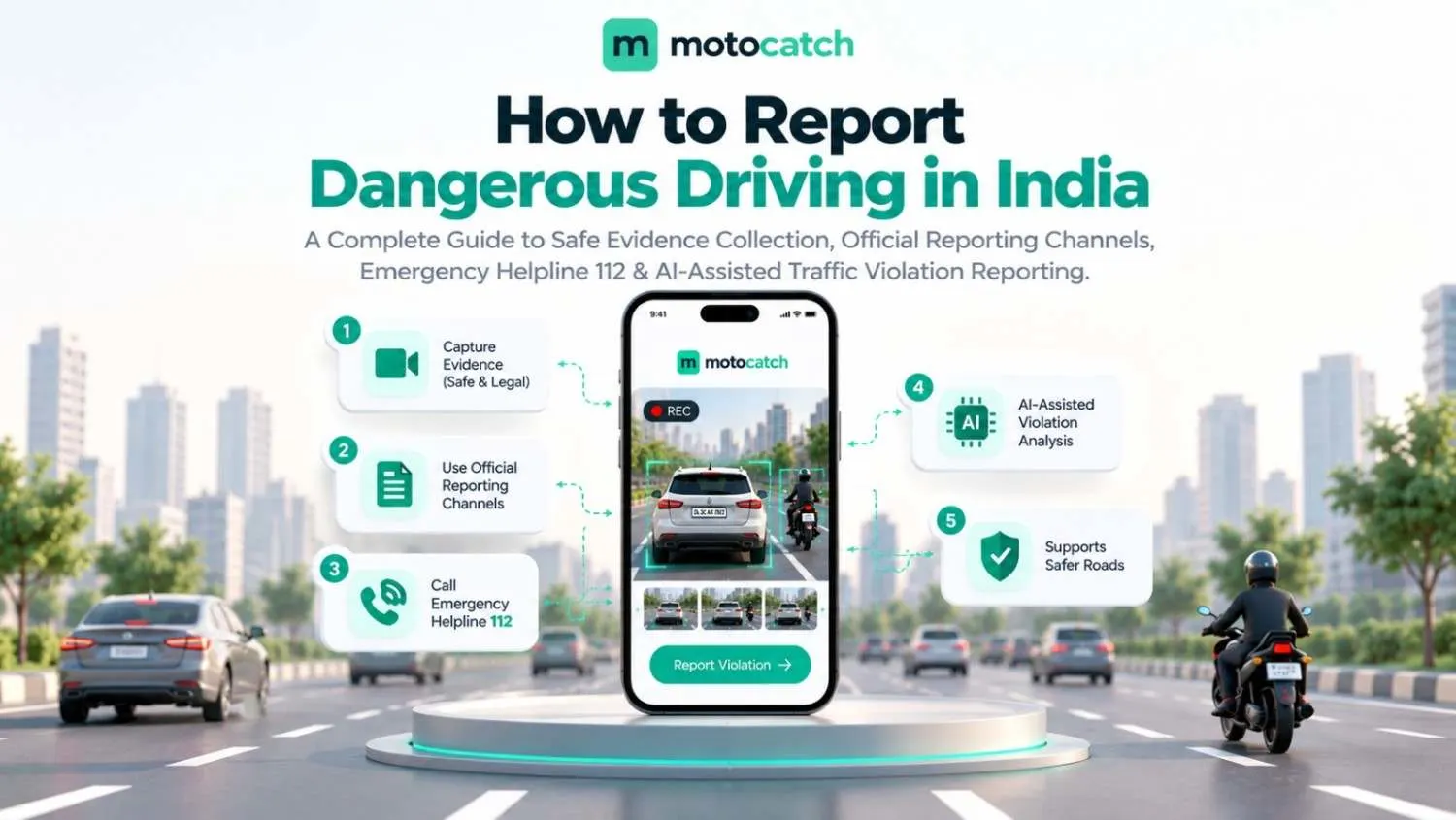
1. Call the Emergency Helpline
For immediate danger — such as an ongoing incident or driving that creates an immediate risk to others — call 112, India's unified emergency number. Provide the vehicle number, your location, the direction the vehicle is heading, and what you observed. The 112 Emergency Response Support System is designed for emergencies involving police, fire, medical and other emergency assistance.
2. Use Your State Traffic Police App or Official Portal
Reporting channels vary by state and authority. Always check the official traffic police or police website for the current reporting process.
Examples include:
- Delhi: Delhi Traffic Police official website — includes a facility to report observed traffic violations.
- Mumbai: Mumbai Police official website — lists its Traffic WhatsApp Helpline and citizen complaint options.
- Karnataka/Bengaluru: Bengaluru Traffic Police official website — check the current complaint/reporting services before submitting.
- Tamil Nadu: Tamil Nadu Police official portal — check the current citizen complaint and traffic-related options.
Because state systems and apps can change, verify the current channel on the relevant authority's official website before submitting a report.
3. Report Through Available Official Social Channels
Some traffic police departments also use official social media or messaging channels for citizen complaints. Availability varies by state.
If your local authority accepts reports through these channels, send the photo or video with the vehicle number, location, date, and time. Keep the description factual and concise.
For example, Delhi Traffic Police currently provides facilities for reporting observed traffic violations through its citizen-facing services.
4. Use the e-Challan System Where Applicable
The national e-Challan system is an official digital traffic-enforcement platform from the Ministry of Road Transport and Highways. However, its functions and citizen-reporting options can vary by state and implementation.
Do not assume that every citizen violation report can be submitted directly through the national e-Challan portal. Check the relevant state traffic police or transport authority for the appropriate reporting channel.
5. Use Motocatch
Motocatch helps prepare and structure evidence for reporting and review.
Instead of positioning the platform as directly issuing or submitting a challan, the workflow is focused on turning captured photo or video evidence into a clearer, structured record that can support the relevant reporting process.
The authority remains responsible for reviewing the evidence and deciding whether enforcement action is appropriate.
What Counts as Dangerous Driving Worth Reporting?
Not every driving annoyance is worth reporting. The focus should be on behaviour that creates a genuine risk to other road users.
Examples include:
- Overspeeding
- Jumping a red light
- Driving against traffic or on the wrong side
- Reckless lane changes or weaving
- Driving while using a mobile phone
- Driving under the influence of alcohol or drugs
- Driving without required protective equipment such as helmets
- Seat-belt violations
- Carrying more passengers than legally permitted
These categories correspond to offences addressed under India's Motor Vehicles Act and related traffic rules, including dangerous driving, excessive speed, drunken driving, safety-belt requirements and protective headgear requirements.
What About Overspeeding?
Overspeeding is a major road-safety concern in India. Government data has consistently identified it as a leading factor in road fatalities. However, the "nearly 70%" figure in the original version should not be presented as a 2025 statistic without an exact 2025 official source.
For example, government data cited in Parliament for earlier years recorded a figure close to 70%, but that does not establish the same percentage for 2025.
How to Report Safely
Your safety comes first.
Never follow or confront the vehicle you are reporting.
Do not:
- Confront the driver.
- Follow the vehicle to get a better angle.
- Take photos or videos while you are moving.
- Put yourself in danger just to capture better evidence.
If a dangerous driver appears to be following you, drive to a police station, petrol station, or another public area with people and security cameras — do not go home.
The goal of reporting dangerous driving is to give authorities the evidence they need to review the incident. Your involvement ends at the submission. What happens next is the authority's responsibility.
What Happens After You Report?
Once a report is submitted through an appropriate official channel, it may be reviewed and verified by the relevant authority.
Depending on the quality of the evidence, the nature of the violation, applicable rules, and the authority's verification process, the report may result in enforcement action.
A clear vehicle number, visible violation, accurate location and time, and usable evidence can make a report easier to review.
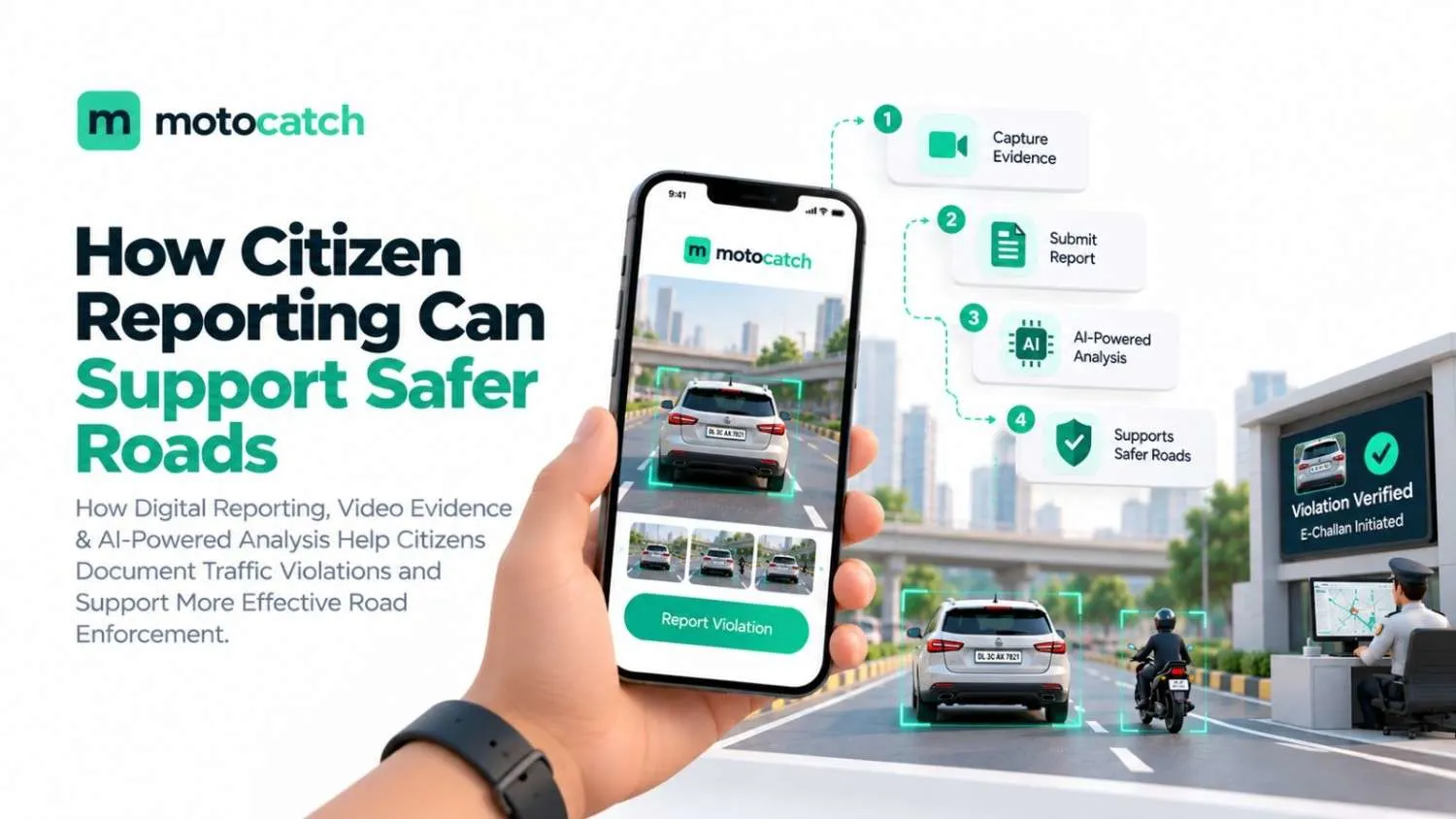
Citizen reporting has been used by traffic authorities in the past and verified citizen reporting, backed by AI and human review, can add a useful layer to enforcement. For example, Delhi traffic police data reported in 2019 showed 31,124 fines in the first six months of that year based on citizen-submitted reports through social media.
However, a citizen report does not automatically mean that a challan will be issued.
Why Citizen Reporting Matters
Traffic cameras and AI enforcement systems cover a growing number of intersections and road stretches across Indian cities. But fixed camera infrastructure cannot cover every road, residential street, rural highway or smaller town.
Citizen reporting can help address this coverage gap by allowing road users to document incidents that may happen outside fixed-camera coverage.
The value is not in replacing traffic police or enforcement infrastructure. It is in providing another source of evidence from the wider road network.