A traffic violation can happen in a few seconds. A driver may jump a red light, drive on the wrong side of the road, use a phone while driving, or ignore a helmet rule before a traffic officer has the opportunity to intervene.
This creates a simple problem: traffic authorities cannot be everywhere at once.
Citizen reporting can help fill part of this gap. With smartphones already widely available, people can record incidents and share them with traffic authorities. When supported by proper verification and digital systems, citizen participation can become a useful additional layer of traffic enforcement.
What Is Citizen Traffic Reporting?
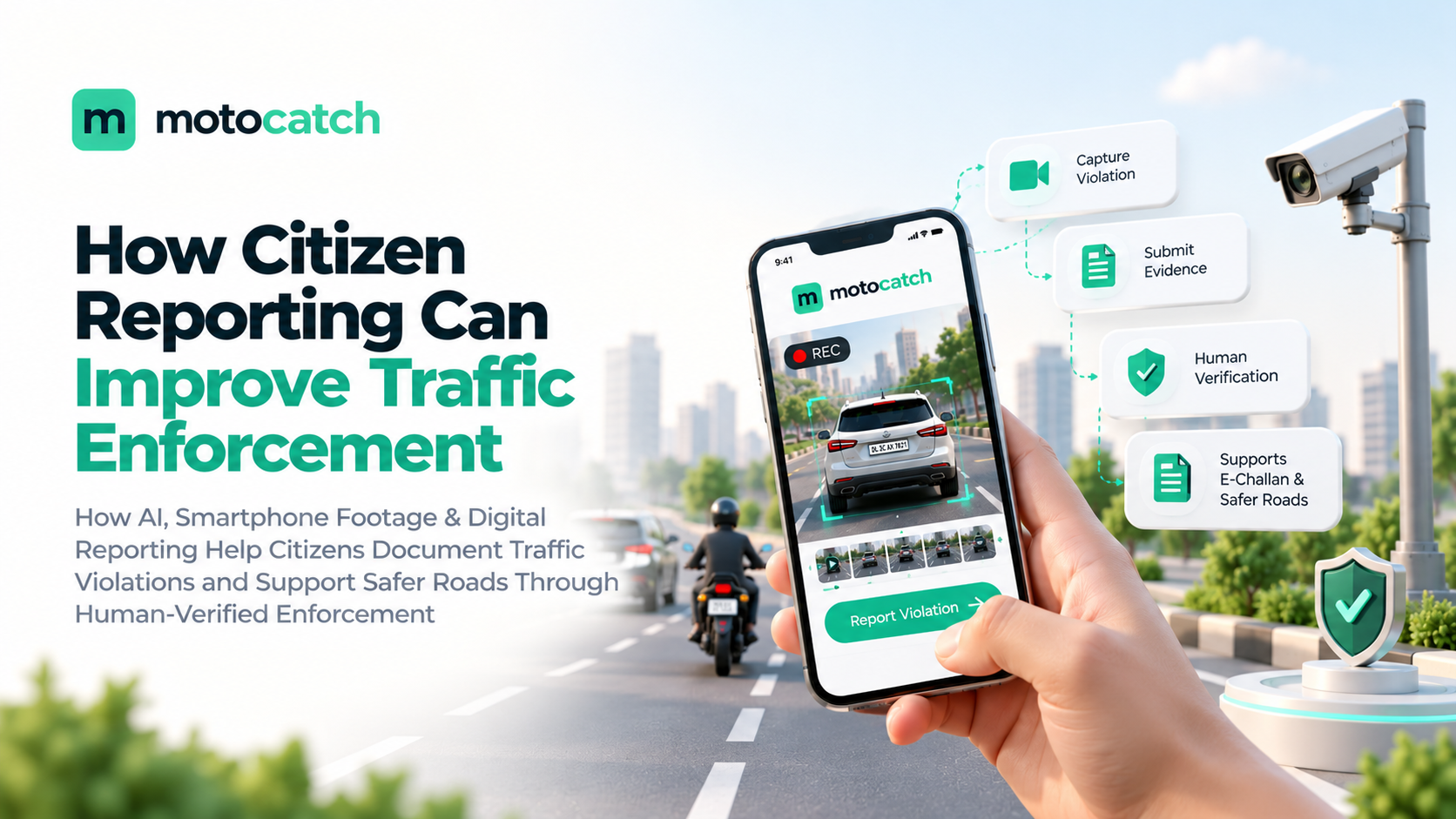
Citizen traffic reporting allows members of the public to report traffic violations using photographs, videos, or other information.
A citizen may witness a violation and submit details such as:
- Photograph or video
- Vehicle registration number
- Location
- Date and time
- Type of violation
The authorities can then review the submission and determine whether further action is appropriate.
The idea is not to replace traffic police. It is to provide authorities with information about incidents that may otherwise go unnoticed.
Delhi's Traffic Prahari Shows the Potential
Delhi's Traffic Prahari programme provides a useful example of citizen participation in traffic enforcement.
According to Delhi Traffic Police's April 2025 newsletter, the programme had 99,643 registered Traffic Praharis and 5,98,226 reported violations.
Citizens can upload photographs and videos along with details such as the date, time, location, registration number, and type of violation. Delhi Traffic Police states that the submitted information is verified and validated before the enforcement process continues.
This demonstrates that citizen reporting can operate as part of an official enforcement workflow rather than simply functioning as informal reporting on social media.
Why Citizen Reporting Can Help
Fixed cameras are valuable, but their coverage is limited to specific locations.
Citizens, on the other hand, are distributed across cities and roads. A person may witness an incident on a road that has no dedicated enforcement camera.
This creates an additional source of information for traffic authorities.
Citizen reporting can be particularly useful for incidents such as:
- Dangerous driving
- Wrong-side driving
- Red-light violations
- No helmet
- Triple riding
- Mobile-phone use while driving
- Other visible traffic violations
The Biggest Challenge Is Not Recording
Smartphones have made recording easy.
The harder problem is turning a recording into information that authorities can actually use.
A useful report may need to establish:
- What happened?
- Which vehicle was involved?
- Where did it happen?
- When did it happen?
- Is the evidence clear enough to review?
A citizen may capture a dangerous incident but have difficulty identifying the vehicle number. The footage may also contain a partially visible plate, poor lighting, or a moving vehicle.
This is where AI can potentially make citizen reporting more practical.
How AI Can Improve Citizen Reporting
AI can help analyze video and extract relevant information from it.
Instead of asking a citizen to manually identify every detail, an AI-powered system can assist with tasks such as:
- Detecting a potential violation
- Identifying the vehicle
- Reading a visible number plate
- Extracting relevant frames
- Organizing incident information
- Preparing a structured report
Human verification remains important. AI should help organize evidence, not independently decide that someone is guilty of a violation.
The Indian government has also emphasized human verification in automated enforcement. A July 2025 parliamentary response stated that AI-generated challans are manually re-verified by dedicated staff at police command and control centres.
Citizen Reporting and India's Digital Traffic Infrastructure
Citizen reporting becomes more useful when it can complement existing digital systems.
India already has a growing digital traffic ecosystem that includes:
- eChallan
- Vahan
- Sarathi
- Intelligent Traffic Management Systems
- eDAR/iRAD
The Ministry of Electronics and Information Technology reports that eChallan has issued more than 37.6 crore e-Challans. It also states that Intelligent Traffic Management Systems across 25 States/UTs and smart cities have generated more than 11.55 crore traffic violation notices.
These systems provide an important digital foundation for technology-supported enforcement.
How MotoCatch.ai Helps Citizen Reporting
MotoCatch.ai focuses specifically on the gap between citizens recording traffic violations and those recordings becoming useful reports.
MotoCatch.ai allows a citizen to use a smartphone to record a traffic violation. AI then processes the footage, identifies the offence, reads the vehicle number plate, and generates a report that can be shared through appropriate channels.
This approach is designed around real road conditions, including partial number plates, poor lighting, moving vehicles, and patchy connectivity.
The key value is not simply recording more videos. It is helping transform raw footage into structured information that can be reviewed.
A More Practical Citizen Reporting Model
A strong citizen-reporting system needs more than participation.
It needs:
| Requirement | Why It Matters |
|---|---|
| Easy reporting | Encourages participation |
| Clear evidence | Helps verification |
| AI processing | Reduces manual effort |
| Vehicle identification | Connects evidence to the vehicle |
| Human review | Reduces incorrect enforcement |
| Privacy safeguards | Protects citizens and drivers |
| Official channels | Connects reports with enforcement |
This makes citizen reporting more responsible and useful.
The Importance of Responsible Reporting
Citizen participation also creates risks if it is not handled carefully.
A reporting system should consider:
- False reports
- Misleading footage
- Privacy
- Secure storage of videos
- Appropriate access to personal information
- Human verification
- Clear rules for enforcement
The goal should be to improve road safety, not create uncontrolled surveillance or encourage public confrontation.
Conclusion
Citizen reporting can give traffic authorities an additional source of information, especially in places where fixed cameras or police officers may not be present.
Delhi's Traffic Prahari programme demonstrates that citizen-generated reports can already become part of an official traffic-enforcement process. The scale of India's digital traffic infrastructure creates further opportunities to connect citizen participation with technology-supported enforcement.
MotoCatch.ai takes this idea further by using AI to process smartphone-recorded traffic footage and help turn it into structured information for reporting.
The bigger opportunity is simple: people already carry cameras everywhere. Technology can help make those cameras more useful for road safety.
MotoCatch.ai is working toward making traffic-violation reporting easier, smarter, and more actionable.