Wearing a helmet is one of the simplest and most effective ways to reduce the risk of serious head injuries in a road accident. Despite traffic laws requiring helmet use, violations continue to be a road safety concern across India.
If you see someone riding a two-wheeler without a helmet, you can document the violation when it is safe to do so and check whether your local traffic police department provides an official channel for reporting it.
Some traffic police departments provide citizen reporting through official websites, apps or other designated channels. A report may include a clear photo or video, the vehicle registration number, and the location and time of the incident. The relevant authority can then review the submitted information according to its process.
Why Reporting Helmet Violations Matters
Helmet laws are intended to reduce the risk of serious injury and death, not simply to ensure compliance with traffic rules.
According to the Ministry of Road Transport and Highways (MoRTH), 54,568 people died in road accidents in 2023 while not wearing helmets, and 1,05,727 people were injured in road accidents while not wearing helmets. These figures highlight the importance of helmet use in protecting two-wheeler riders and passengers.
Source: MoRTH Road Accidents in India 2023 Report
Traffic police cannot monitor every road and street continuously. Citizen reporting can provide authorities with information about potential violations in locations not regularly covered by enforcement or fixed cameras.
How to Report a Helmet Violation in India
The reporting process varies by state and authority. However, the following steps can help you prepare a useful report.
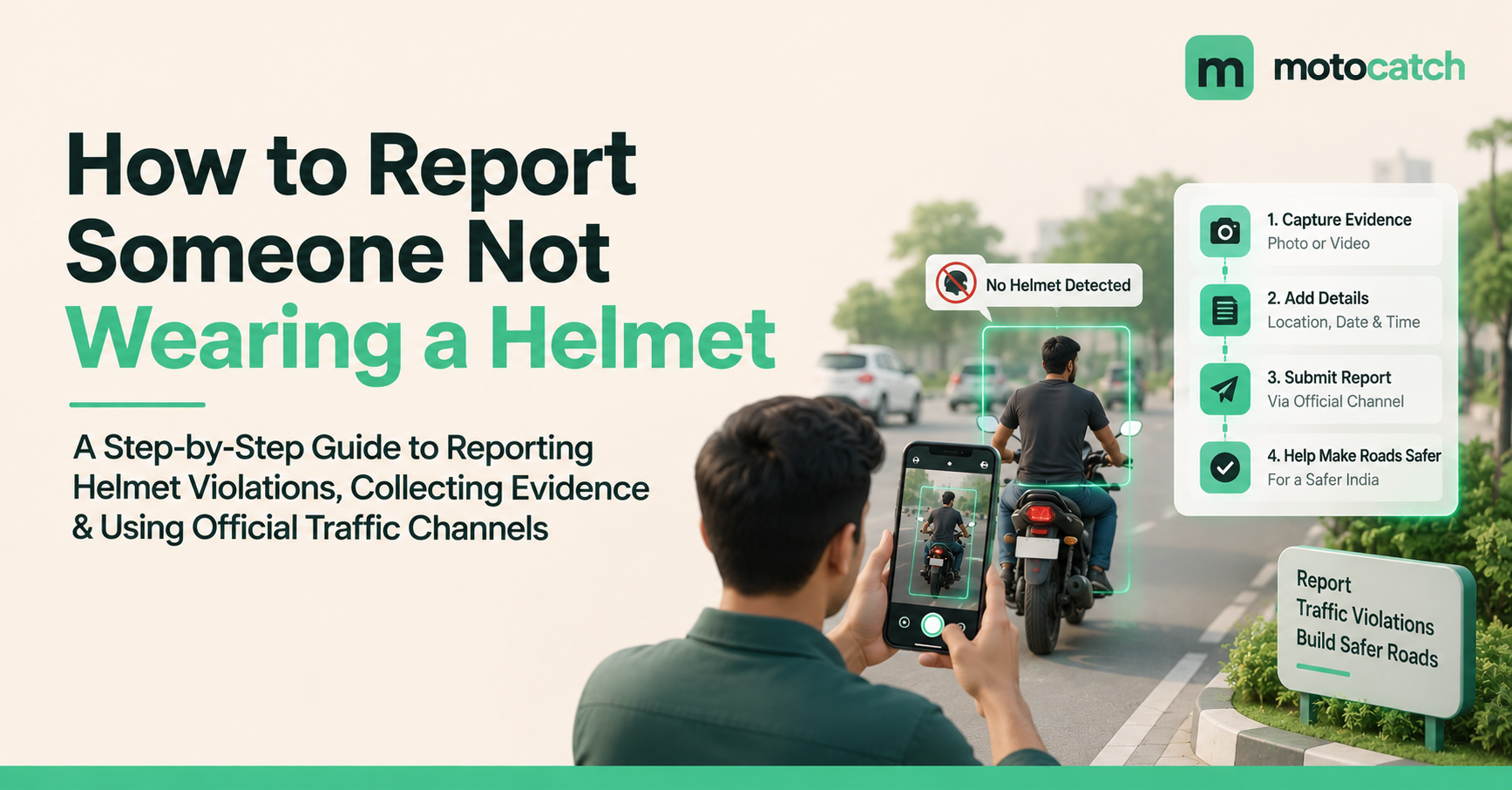
1. Gather Evidence of the Violation
When it is safe to do so, capture a photo or video of the helmet violation. The evidence should clearly show the violation and, where possible, the vehicle involved.
Never record while driving or put yourself at risk to capture evidence.
2. Record the Vehicle Registration Number
Note the vehicle registration number and ensure it is readable in the captured evidence. An unclear or incomplete number may make it harder for the relevant authority to identify the vehicle.
3. Record the Location and Time
Note the location, date and approximate time of the incident. These details provide context that may help the authority review the report.
4. Submit the Report Through the Official Channel
Check your state or city's official traffic police website to find out whether citizen reporting is available and how to submit a complaint.
Depending on the authority, reporting may be available through an official website, mobile app or another designated channel. Do not assume that the national e-Challan portal accepts direct citizen reports in every state.
5. Keep the Reference Number
If the authority provides a complaint or reference number, save it for future reference. You may need it if you want to follow up on your report.
What Information Should You Include?
Providing complete and accurate information can help the relevant authority assess a report.
Your report should include:
- A clear photo or video showing the helmet violation
- The vehicle registration number, if visible
- The date and time of the incident
- The location where the incident occurred
- A brief, factual description of the violation
Clear evidence and accurate details can help authorities review the incident. However, submitting a report does not guarantee enforcement action.
Common Mistakes to Avoid While Reporting
To help keep your report useful and credible, avoid these mistakes:
- Uploading unclear or low-quality images
- Providing an incomplete or incorrect vehicle registration number
- Editing or altering images and videos in ways that change the evidence
- Recording while driving
- Submitting false or duplicate complaints
Accurate reporting helps authorities assess genuine violations and reduces the risk of misleading information.
How MotoCatch Helps Citizens Report Helmet Violations
Traditional reporting methods may require citizens to organise evidence and vehicle details themselves. This can make the process more difficult, particularly when the captured footage needs to be reviewed and its relevant information identified.
MotoCatch uses AI-based processing to help identify helmet violations and OCR technology to read vehicle registration numbers from captured images, where the footage permits.
The application helps process the captured evidence and structure the relevant information for reporting and review.
Processing results depend on footage quality and operating conditions. Moving vehicles, partially visible number plates, poor lighting and patchy network connectivity can affect processing accuracy and reliability.
The relevant authority remains responsible for reviewing the report and deciding whether enforcement action is appropriate.
Conclusion
Knowing how to report a helmet violation in India can help road users contribute to safer roads. Clear evidence, accurate vehicle details and the correct reporting channel can help authorities review potential violations.
Fixed-camera infrastructure may not cover every road. Citizen-generated footage, supported by AI-based evidence processing, can provide an additional source of information for reporting and review.
MotoCatch helps process captured footage and structure relevant information, while the appropriate authority retains responsibility for verification and enforcement decisions.